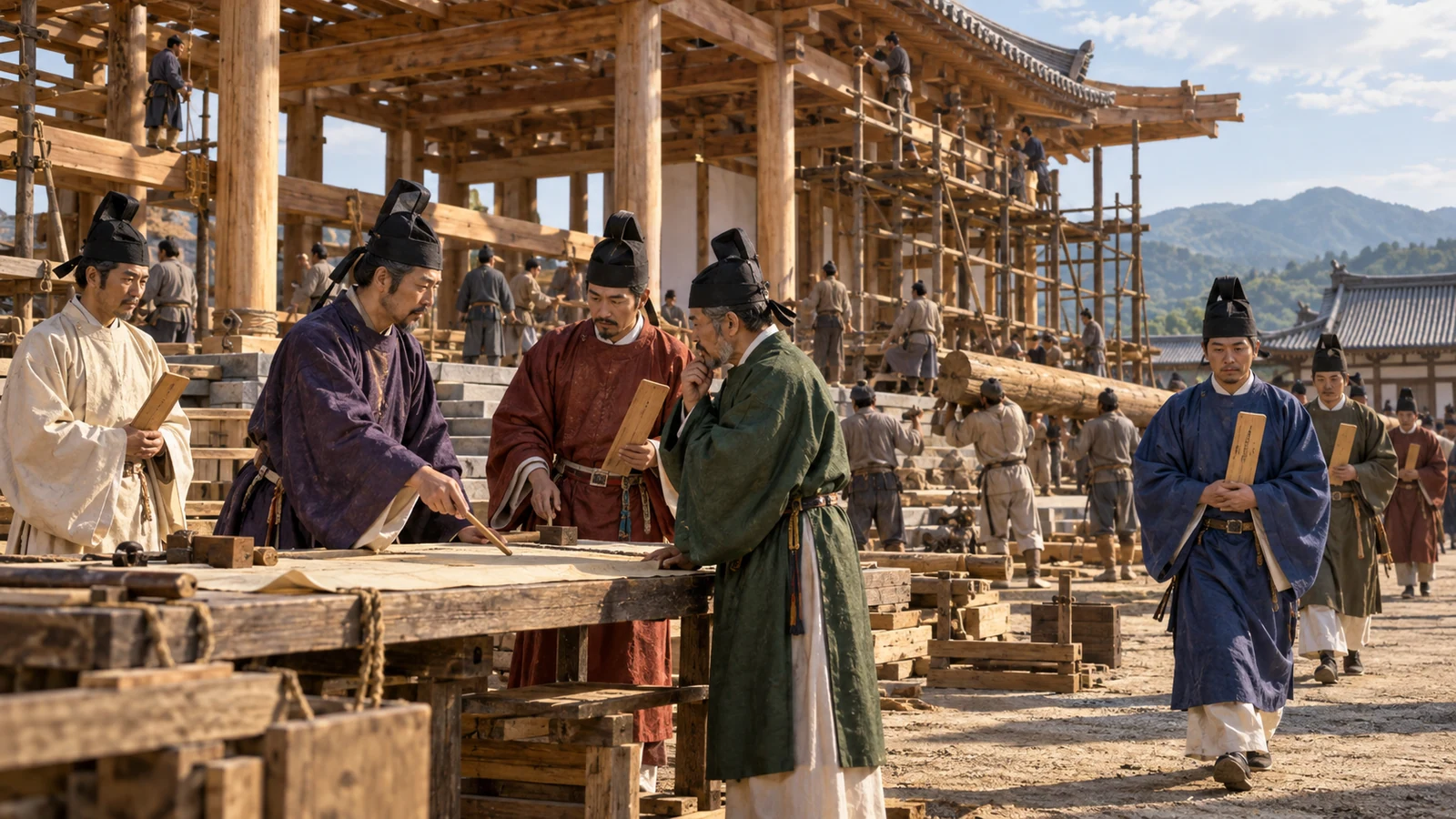
645–701 · From coup to legal codes
The Taika reforms were not a single-day change
Separate the assassination of Soga no Iruka from the later formation of state institutions.
A coup is not a completed administrative reform
The Isshi Incident of 645 removed Soga no Iruka and changed political leadership. It did not complete land administration, population registration and revenue collection on that day. Separating the coup from the wider reform reveals subsequent institutional work.
The later-compiled Nihon Shoki records an edict in 646, with possible projection of subsequent institutions. A stated programme differs from evidence of its complete application. Officials, records and communications were necessary between policy and practice.
Connecting people, land and obligations
Population registers helped define land allocations and obligations through residence, age and status. The Kōgo register of 670 marks that work. Central administration required information about distant communities in usable form.
Provincial officials sent from the centre differed from district officials drawn from local influential families. New offices incorporated existing relationships. Records, stores and communications needed people and facilities to make rules work.
Institutional development towards 701
The Taihō Code of 701 established administrative and penal arrangements decades after 645. Rules provided continuing standards across changes of personnel. The coup and the code therefore represent different dimensions of state formation.
Classification connected land use with taxes and labour obligations. A palace-only account misses villages and offices. The sequence of coup, programme, registers and code traces political change into everyday administration.
Before and after
- 645
Soga no Iruka is killed in the Isshi Incident.
- 646
The chronicle records the reform edict.
- 670
The Kōgo population register is compiled.
- 701
The Taihō Code is established.
Key terms
- Isshi Incident
- The coup killing Soga no Iruka in 645.
- Population register
- Household records supporting taxation and administration.
- Penal and administrative codes
- A legal system defining penal and administrative rules.
What supports the account?
The coup and legal-code formation were not simultaneous.
The museum chronology records stages between 645 and 701.
Do not assign completion of every institution to 645.
Reform concerned control of land, people and taxation.
The town history explains centralising policy and regional systems.
Declared policy need not equal practice everywhere.
Check your understanding
Choose an answer to reveal the explanation. Return to the article and sources when you are unsure.
Sources
- Asuka Historical Museum chronology奈良文化財研究所
The coup, edict, 670 register and 701 code.
- Onga town history: Nara and Heian periods遠賀町
Reform policy, central and regional administration, taxation and legal codes.
Keep exploring
588–694 · Palaces and temples in Asuka
Temples rise in Asuka
Palaces, tiles and a water clock reveal a changing political and cultural centre.
Asuka, Nara
1730–1869 · Dōjima rice market
Setting prices in a city receiving rice
Domain warehouses, rice receipts and contracts connected rice to money in Osaka.
Dōjima, Osaka
Eighteenth century–mid-Meiji · Sea of Japan routes
Trading at each port aboard a kitamae ship
Rice, kelp, herring and used clothes: voyages profited from trading, not only freight.
Hashitate, Ishikawa / Ishikari, Hokkaidō / Osaka