588–694 · Palaces and temples in Asuka
Temples rise in Asuka
Palaces, tiles and a water clock reveal a changing political and cultural centre.
Buddhist temples beside political centres
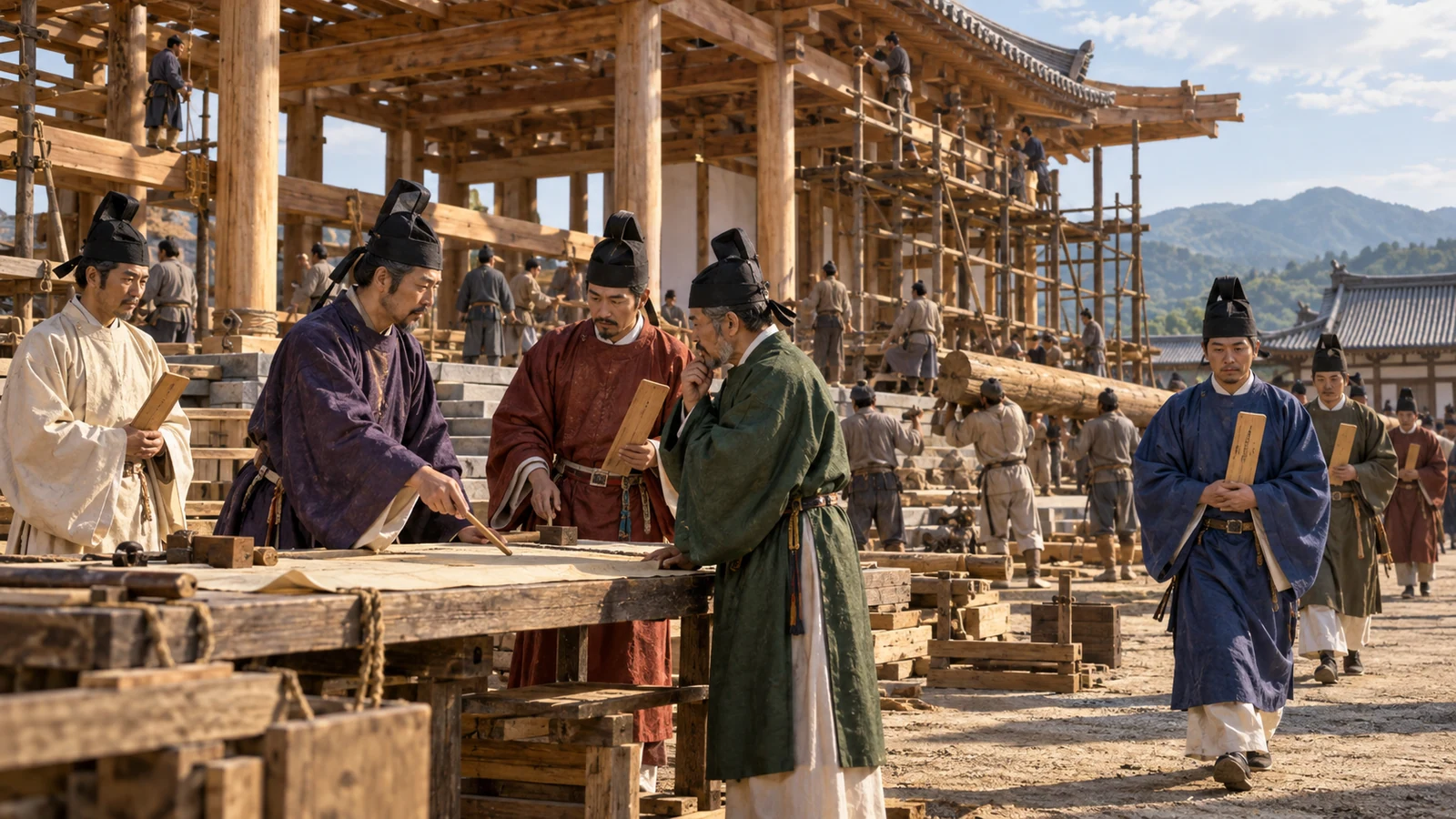
Construction of Asukadera began in 588 and required columns, foundation stones and roof tiles alongside images and scriptures. Heavy tiled roofs needed supporting structures, while tiles had to be formed and fired. Adopting Buddhism also brought people and materials capable of realising a new kind of architecture into the political centre.
Palaces shifted and additional temples appeared rather than forming one permanently fixed city. Governmental and religious spaces served different purposes while developing within the same area. Change continued in stages before the move to Fujiwara-kyō.
Construction recorded in tiles and foundation stones
A tiled roof required an appropriate supporting structure. Stones and fired tiles survive where timber does not. Comparing their forms and decoration helps investigate building layouts and technical connections, preserving evidence from manufacture as well as construction.
Channels and traces of a wooden box at Mizuochi, considered alongside the written account of a clepsydra, indicate a water-clock facility. Measuring flow and announcing time could coordinate ceremony and administration. Continued water supply, maintenance and people announcing the time were essential to its operation.
From Asuka to Fujiwara-kyō
Between Suiko’s accession in 592 and the move to Fujiwara-kyō in 694, political and religious buildings changed. Their separate construction and repair dates preserve the sequence of development instead of suggesting one unchanging landscape.
Moving the court did not erase every temple or belief. Foundation stones and tiles record construction after the political centre moved elsewhere. Following palaces and temples together shows the accumulation of experience in gathering labour, materials and technologies before later capitals.
Before and after
- 588
Construction of Asukadera begins.
- 660
Period associated with the water clock at Mizuochi.
- 694
The capital moves to Fujiwara-kyō.
Key terms
- Roof tile
- Fired roofing material useful for tracing techniques and workshops.
- Archaeological feature
- Surviving traces such as postholes, foundations and channels.
- Water clock
- A device measuring time through the movement of water.
What supports the account?
Palaces and temples clustered at Asuka.
Excavations and museum displays document their locations.
Not every reconstructed roof or colour survived directly.
Mizuochi contained water-clock equipment.
Physical features are studied alongside written accounts.
The model is an interpretive reconstruction.
Check your understanding
Choose an answer to reveal the explanation. Return to the article and sources when you are unsure.
Sources
- About the Asuka Historical Museum奈良文化財研究所
Start of Asukadera construction, palace chronology and water-clock displays.
- Time Memorial Day and Asuka Mizuochi奈良文化財研究所
Excavated water installations and wooden box at Mizuochi, and interpretive water-clock and site models based on historical references.
Keep exploring
645–701 · From coup to legal codes
The Taika reforms were not a single-day change
Separate the assassination of Soga no Iruka from the later formation of state institutions.
Asuka, Nara / Naniwa, Osaka710–784 · Interrupted by temporary capital moves
The work that sustained Heijō-kyō
Avenues and offices reveal how the Nara capital functioned.
Heijō-kyō, Narac. fifth century · Kofun period
The society that built giant burial mounds
Daisen Kofun in Sakai links monumental tombs with emerging royal power.
Sakai, Osaka