710–784 · Interrupted by temporary capital moves
The work that sustained Heijō-kyō
Avenues and offices reveal how the Nara capital functioned.
A city and its government precinct
Wooden labels excavated at Heijō palace record supplies from the provinces. Officials and workers required food whose contents and origins could be checked. Founded as a capital in 710, Heijō-kyō depended on production and transport linking provincial communities with the gridded town and its northern administrative compound.
Major avenues divided the city and established ceremonial approaches. Left and right were named from the ruler’s south-facing position, reversing the intuitive reading of a north-up map. Urban organisation expressed a political viewpoint as well as a street grid.
Receiving supplies and administering them
Offices needed to record the types and origins of arriving goods. Wooden tablets served as labels and administrative records. Writing, counting and storing were everyday tasks behind monumental gates, connecting provincial supplies to the offices receiving them.
Officials and workers needed food, and buildings needed repair. Concentrating supplies supported the capital while imposing work on the places providing them. Origins written on tablets make the connections between provincial production, transport and central activity tangible.
Moving capitals and altered buildings
From 740 the political centre moved among Kuni, Naniwa and Shigaraki before returning in 745. The Daigokuden was dismantled and moved during these changes, and a later hall stood elsewhere at Heijō. The two sites do not represent two halls planned for simultaneous use: they record relocation and reorganisation.
After the move to Nagaoka in 784, the land and temples continued their own histories. Modern reconstructions interpret foundations and documents. Streets, tablets and layouts together reveal an administrative city linked to wider regions, even where its timber buildings are gone.
Before and after
- 710
Move from Fujiwara-kyō to Heijō-kyō.
- 740
Move to Kuni-kyō.
- 745
Return to Heijō-kyō.
- 784
Move to Nagaoka-kyō.
Key terms
- Heijō Palace
- The compound containing imperial residence, ceremonial and administrative spaces.
- Suzaku Avenue
- The main north–south avenue of the capital.
- Left and right districts
- District names based on an emperor facing south.
What supports the account?
Capital and palace cover different areas.
The park’s plans distinguish the city and palace.
The present park is not the entire ancient city.
The capital temporarily moved elsewhere.
The chronology records moves during 740–745.
Do not place the whole Nara period in one uninterrupted capital.
Check your understanding
Choose an answer to reveal the explanation. Return to the article and sources when you are unsure.
Sources
- What was Heijō-kyō?国営平城宮跡歴史公園
The 710 move, city grid, palace functions and district positions.
- History of Heijō-kyō国営平城宮跡歴史公園
Capital moves in 740–745 and the 784 move to Nagaoka.
- Wooden tablets from Heijō palace and capital奈良文化財研究所
Supply labels, find contexts and examples of administrative and transport records.
Keep exploring
756 · Empress Kōmyō’s donation
Objects preserved at Shōsōin
Imperial belongings and a surviving storehouse connect Nara culture with preservation.
Shōsōin, Nara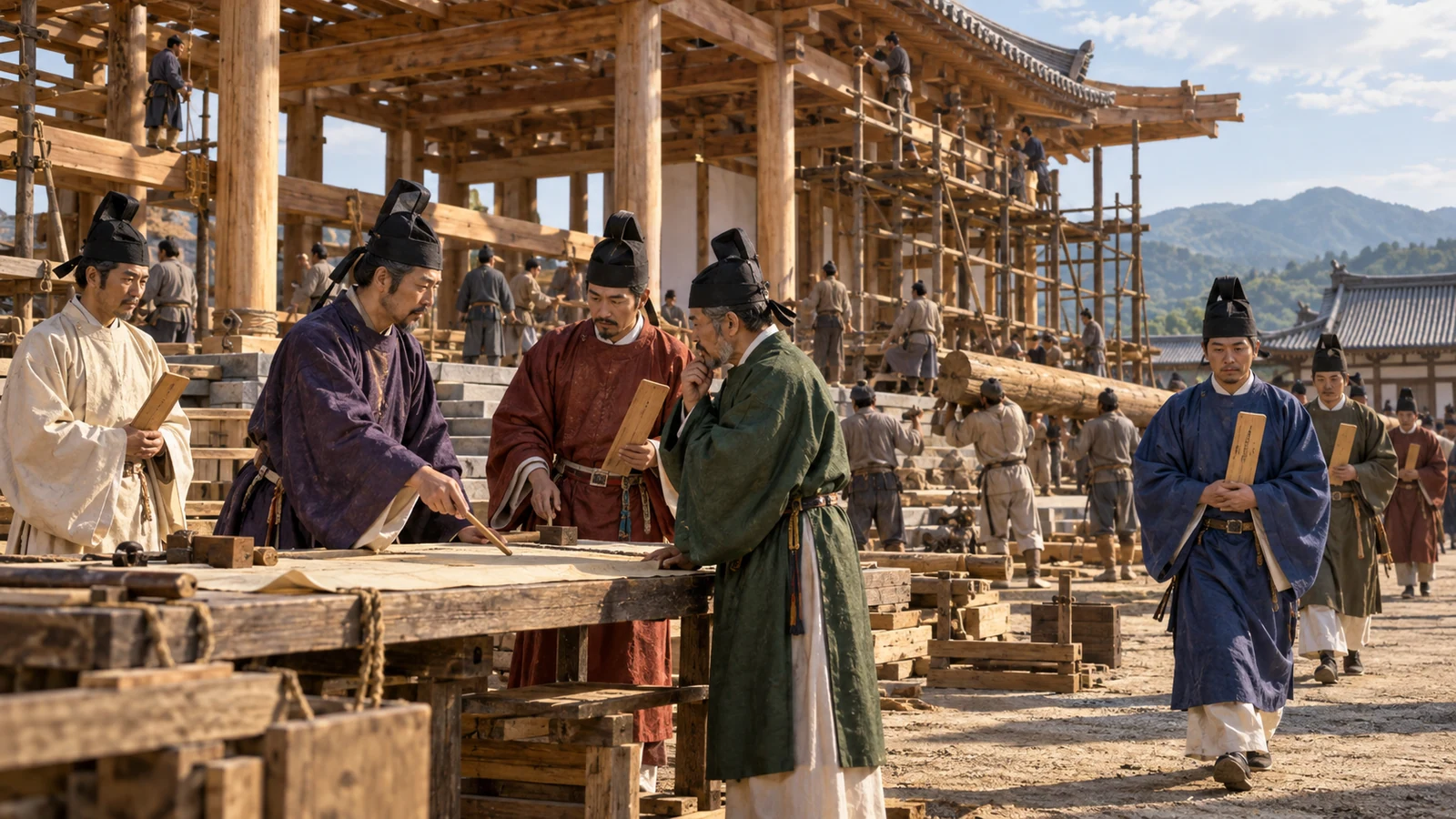
645–701 · From coup to legal codes
The Taika reforms were not a single-day change
Separate the assassination of Soga no Iruka from the later formation of state institutions.
Asuka, Nara / Naniwa, Osaka588–694 · Palaces and temples in Asuka
Temples rise in Asuka
Palaces, tiles and a water clock reveal a changing political and cultural centre.
Asuka, Nara