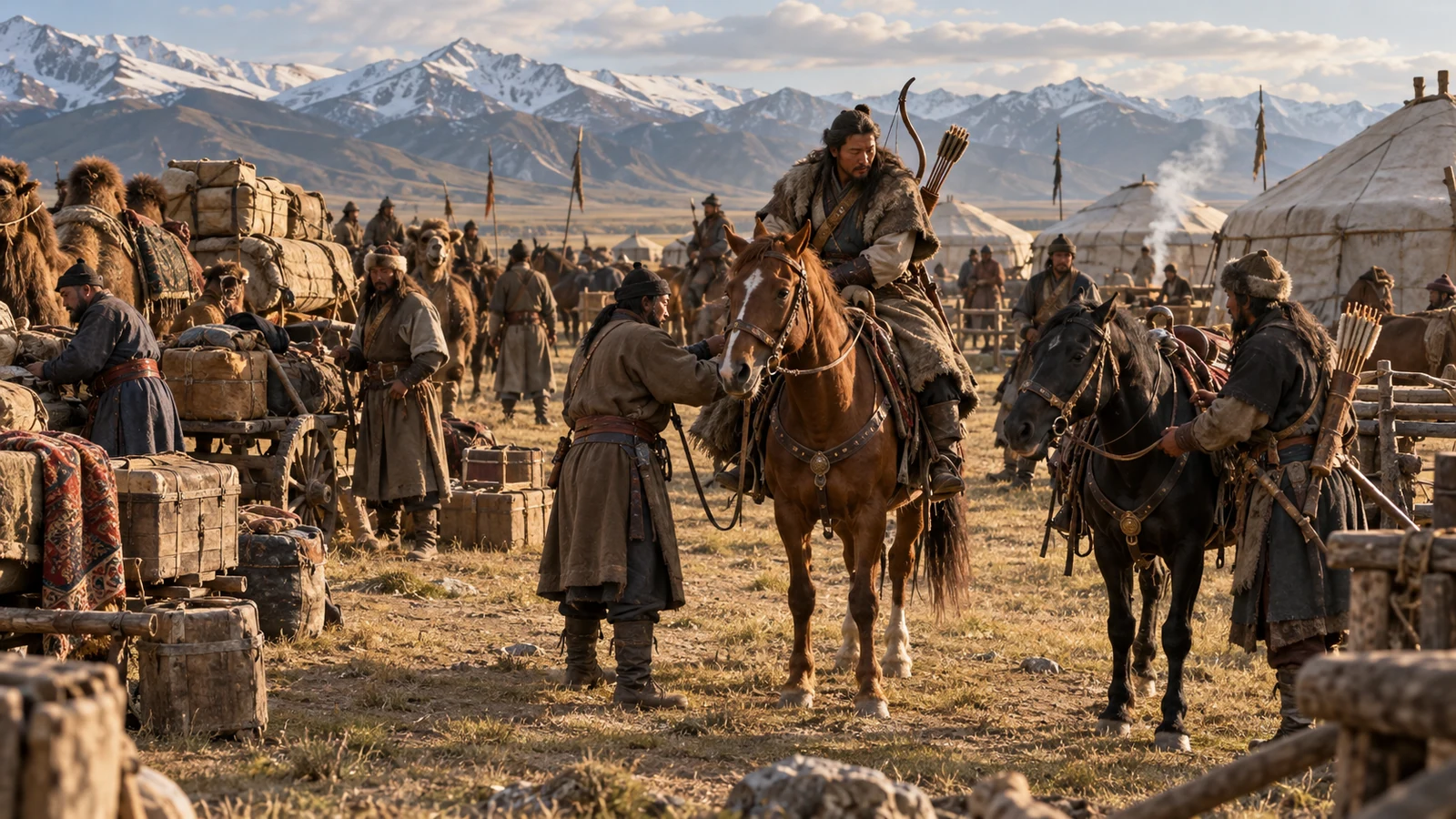
Mainly 1206–1368
Routes and people in the Mongol Empire
Read the violence of conquest alongside exchanges across imperial space.
From steppe power to empire
Long-distance connections and the violence obtaining territory belong to the same history. After unification in 1206, Ögödei and other successors continued conquests involving urban destruction, killing and forced artisan relocation. Later exchange does not cancel that harm.
Stations and artisans connecting territories
Stations supplied travelers and horses for onward stages, organizing communication across distance. Rule also depended on regional specialists. The movement of craftspeople did not always mean voluntary journeys or favorable conditions.
Courts used Confucian scholars, Tibetan Buddhists, physicians and astronomers. Capital and canal projects joined regional knowledge, without identical freedom or benefits for every participant.
Exchange and coercion in one history
A vast imperial map did not eliminate succession conflicts and regional politics. Yuan rule ending in China in 1368 did not end every Mongol polity. Connections must be located in particular places, periods and conditions.
Before and after
- 1206
Chinggis Khan’s consolidation.
- 1229–1241
Expansion under Ögödei.
- 1258
Mongol forces conquered Baghdad.
- 1368
Yuan rule in China ended.
Key terms
- Postal station
- A node supporting relayed travel and orders.
- Succession
- Inheriting a ruler’s position.
- Pax Mongolica
- A label for stable exchanges under Mongol rule, not denial of all violence.
What supports the account?
Conquests continued after Chinggis Khan, notably under Ögödei. Separate periods rather than treating the whole empire as one lifetime’s map.
Government, trade, artisans, coercion and cultural exchange. Scholarship, roads, stations and advisers.
There is no consensus on one cause of conquest.
Roads and stations supported people and technologies. Improved travel conditions differ from forced relocation after conquest.
Government, trade, artisans, coercion and cultural exchange. Scholarship, roads, stations and advisers.
Station networks do not prove universal freedom or safety.
Check your understanding
Choose an answer to reveal the explanation. Return to the article and sources when you are unsure.
Sources
- The Mongols in World HistoryColumbia University
Government, trade, artisans, coercion and cultural exchange.
- A new look at Mongol contributionsColumbia University
Scholarship, roads, stations and advisers.
- Successor and expansionColumbia University
Expansion under Ögödei and succession difficulties.
Keep exploring

Comparing 1377 and the 1450s
Gutenberg and the work of movable type
Type, printing and hand decoration reveal workshop processes.
Mainz / Cheongju
1405–1433
Zheng He’s fleets and Indian Ocean ports
Read Ming expeditions through charts, winds and port labor.
Nanjing / Calicut (Kozhikode)
690–705
Wu Zetian and Buddhist art at Luoyang
An emperor in her own right and Buddhist imagery in political life.
Luoyang