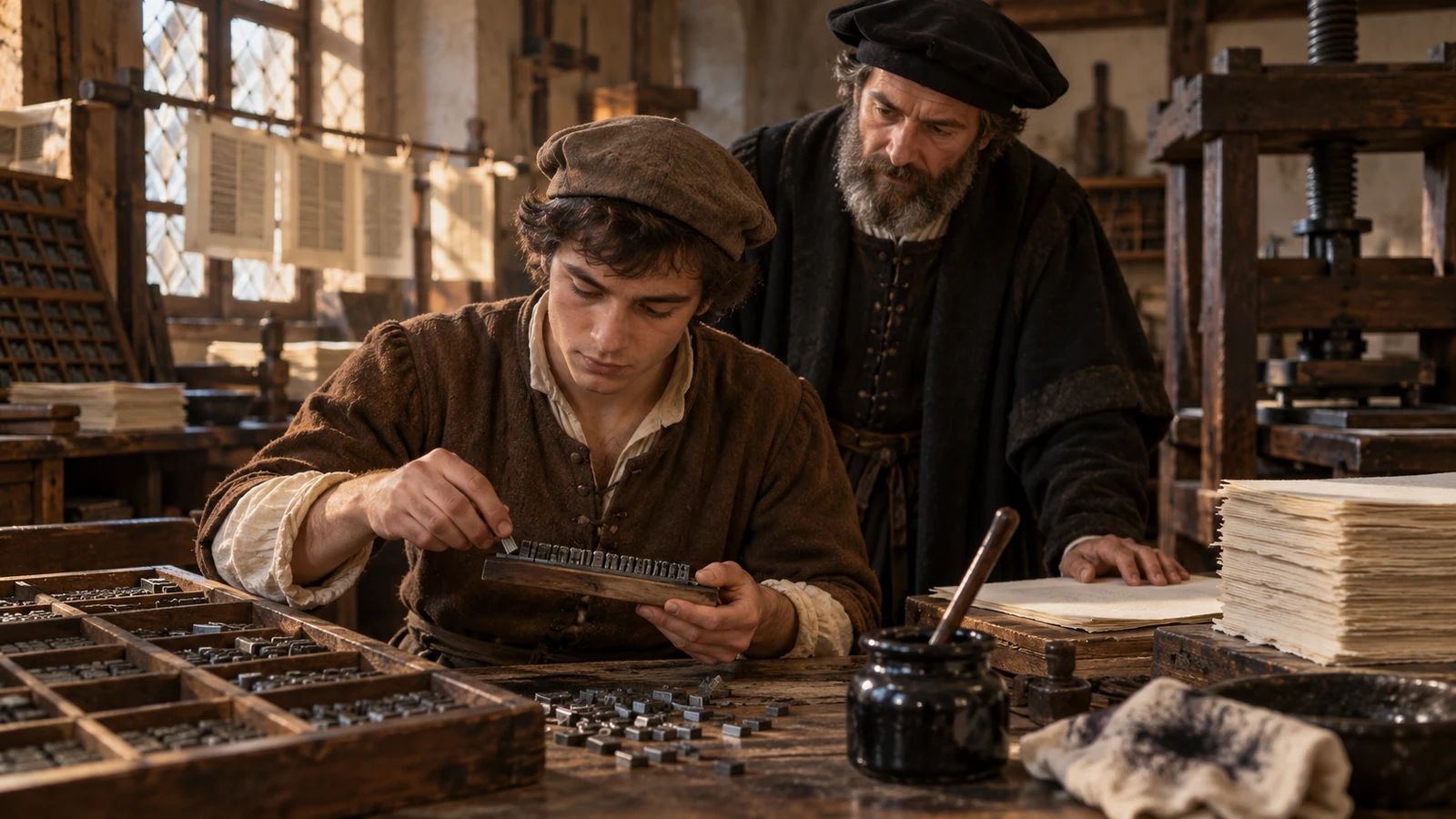
Around 1455 · Mainz · An early movable-type workshop
Set type is not yet a book
Martin, a Mainz printing apprentice
Find errors in a proof and hand on a readable page.
Repeatable type can reproduce an error as readily as a correct line.
Begin the storyPreparing your story…
Explore the diagram: Type can be used beyond one page
Type can be used beyond one page
How does assembling individual letters differ from carving a whole page?
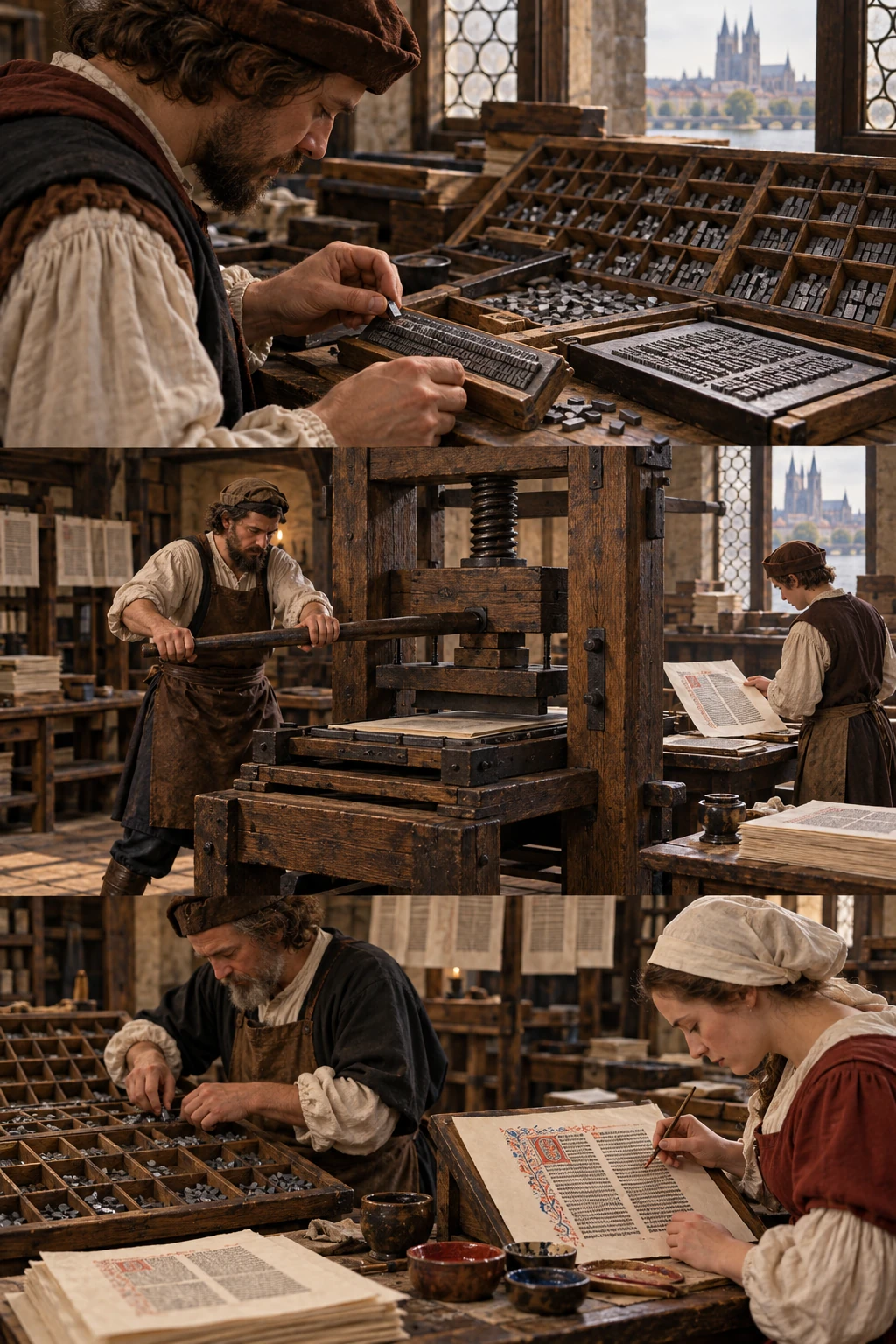
A setting of letters before transfer to paper.
Individual letters can be rearranged
Individual metal letters form lines and pages. These demonstration letters are not a historical Bible text. Unlike a carved page, separate type can be rearranged for another text.
Sources and scope
These illustrations explain processes and institutions rather than reconstructing actual people, buildings or layouts. Cutaways and insets show hidden structures or separate locations.
The Gutenberg Bible ↗The invention of printing ↗Martin, nineteen, the older printer, dialogue and these pages are fictional. Gutenberg’s exact press construction is not established; images and interactions are models informed by later knowledge. Numerical tasks are not historical labor or print-run figures.
Explore the time and placeSources
- The Gutenberg Bible ↗
Library of Congress · The Western European metal-type Bible, production and materials.
- Jikji, 1377 ↗
UNESCO · The oldest surviving metal-type printed book, produced at Cheongju.
- Page from the Gutenberg Bible ↗
British Library · Hand-added decoration and heading on a 1455 page, shelfmark C.9.d.3.
- The Invention of Printing ↗
The Morgan Library & Museum · Consistent pressure and the probable screw press; exact workshop equipment remains uncertain.
- Printing Press Background Information ↗
IEEE REACH · Type, ink, dampened paper and hand-press operation, used as a general educational process.