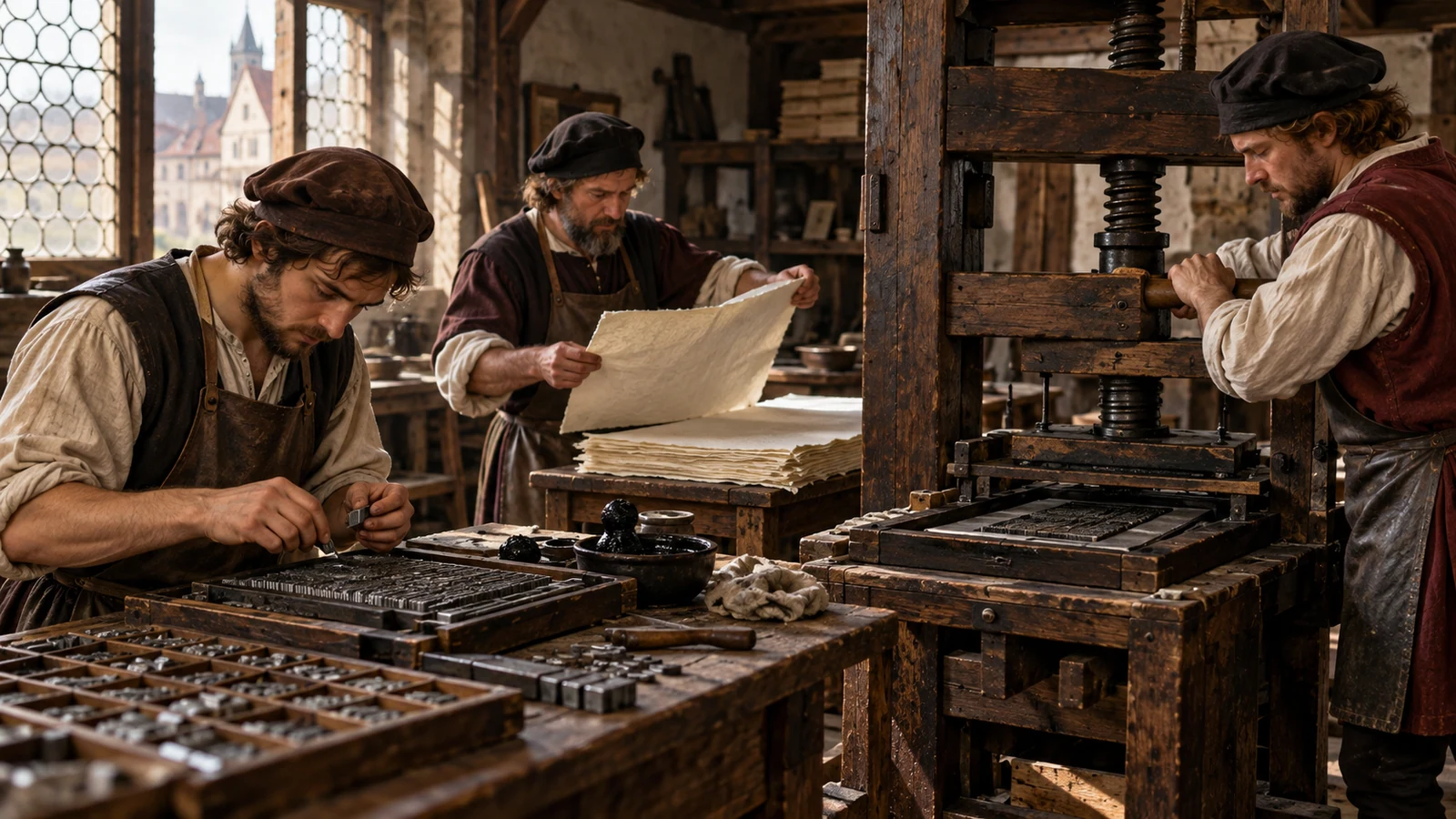
Comparing 1377 and the 1450s
Gutenberg and the work of movable type
Type, printing and hand decoration reveal workshop processes.
Type can be used beyond one page
How does assembling individual letters differ from carving a whole page?
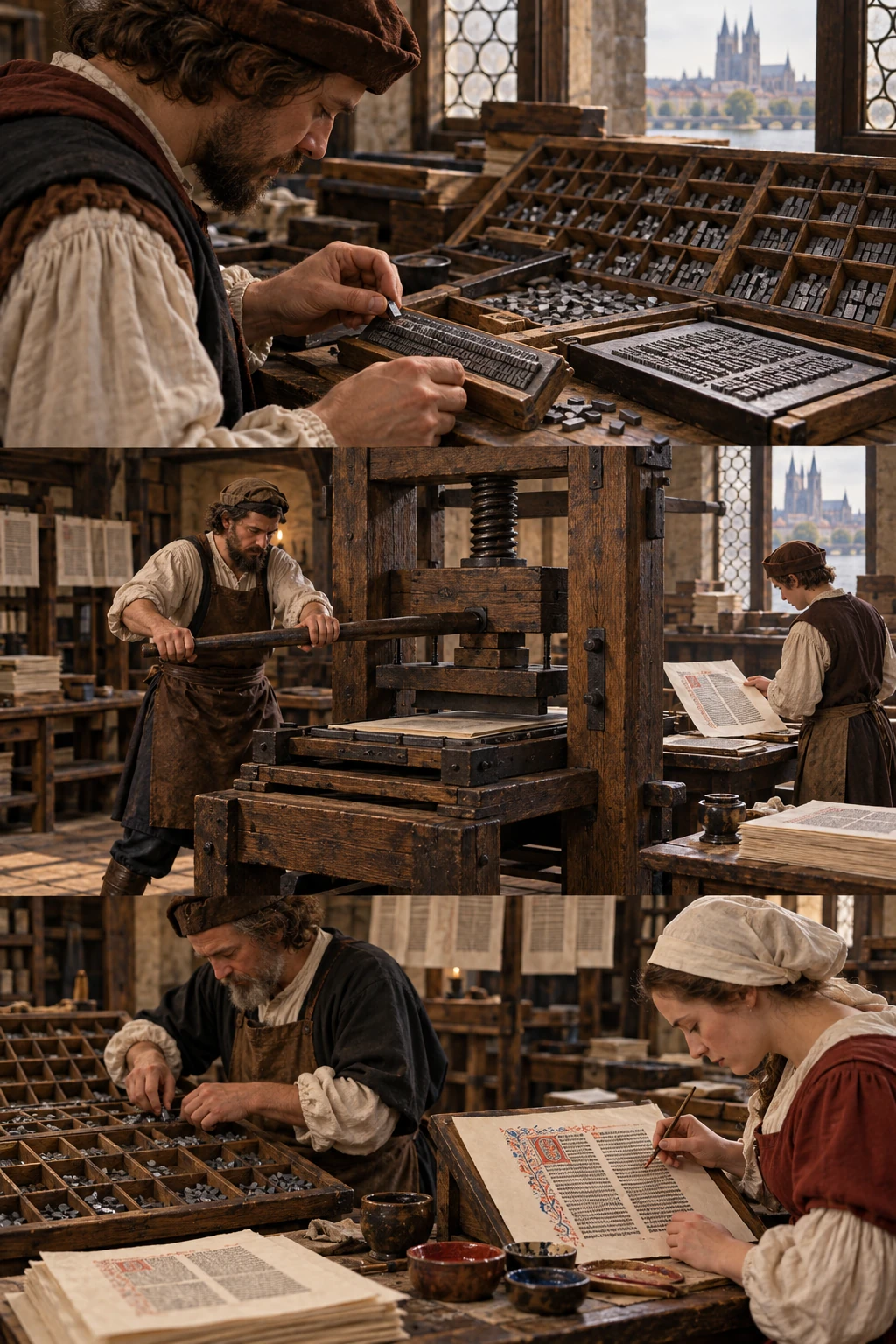
A setting of letters before transfer to paper.
Individual letters can be rearranged
Individual metal letters form lines and pages. These demonstration letters are not a historical Bible text. Unlike a carved page, separate type can be rearranged for another text.
Sources and scope
These illustrations explain processes and institutions rather than reconstructing actual people, buildings or layouts. Cutaways and insets show hidden structures or separate locations.
The Gutenberg Bible ↗The invention of printing ↗Mainz within printing’s world history
Copies printed from the same text could receive different colored initials. Gutenberg’s Bible combined printing and handwork. Metal type did not begin solely in Europe: Jikji survives from Cheongju in 1377.
Making books with reusable type
Type was composed, inked and pressed onto paper or vellum, checked and disassembled for reuse. A long Bible required repeated cycles of supply, composition and correction. Equipment did not remove this continuing labor.
Pages combining print and handwork
Printing alone did not finish the volume. Headings, decorated initials and binding remained. Standardized reproduction changed the division of bookmaking work without instantly eliminating manual finishing.
Before and after
- 1377
Jikji printed with metal type at Cheongju.
- Around 1454–1455
Production of the Gutenberg Bible.
- 1930
The Library of Congress acquired its vellum Bible.
- 2001
Jikji entered the Memory of the World register.
Key terms
- Movable type
- Individual letter elements arranged for printing.
- Hand decoration
- Color or decoration added by hand.
- Proofreading
- Checking and correcting errors.
What supports the account?
The oldest surviving metal-type book and an influential Western European publication answer different questions. Specify the region when discussing firsts.
The Western European metal-type Bible, production and materials. The oldest surviving metal-type printed book, produced at Cheongju.
Oldest surviving does not mean the first work ever produced.
An unchecked type setting can reproduce one mistake on many sheets. Reproduction also calls for checking and correction.
The Western European metal-type Bible, production and materials. The oldest surviving metal-type printed book, produced at Cheongju.
Imagined workshop conversation is not a production record.
Check your understanding
Choose an answer to reveal the explanation. Return to the article and sources when you are unsure.
Sources
- The Gutenberg BibleLibrary of Congress
The Western European metal-type Bible, production and materials.
- Jikji, 1377UNESCO
The oldest surviving metal-type printed book, produced at Cheongju.
- Page from the Gutenberg BibleBritish Library
Hand-added decoration and heading on a 1455 page, shelfmark C.9.d.3.
Keep exploring

1405–1433
Zheng He’s fleets and Indian Ocean ports
Read Ming expeditions through charts, winds and port labor.
Nanjing / Calicut (Kozhikode)
1428–1453
Joan of Arc and the siege of Orléans
Read siege, coronation and trial within the Hundred Years War.
Orléans
Notebooks from around 1487–1505
Reading Leonardo’s notebooks
Water, weights and anatomy reveal observation and design.
Milan / Florence