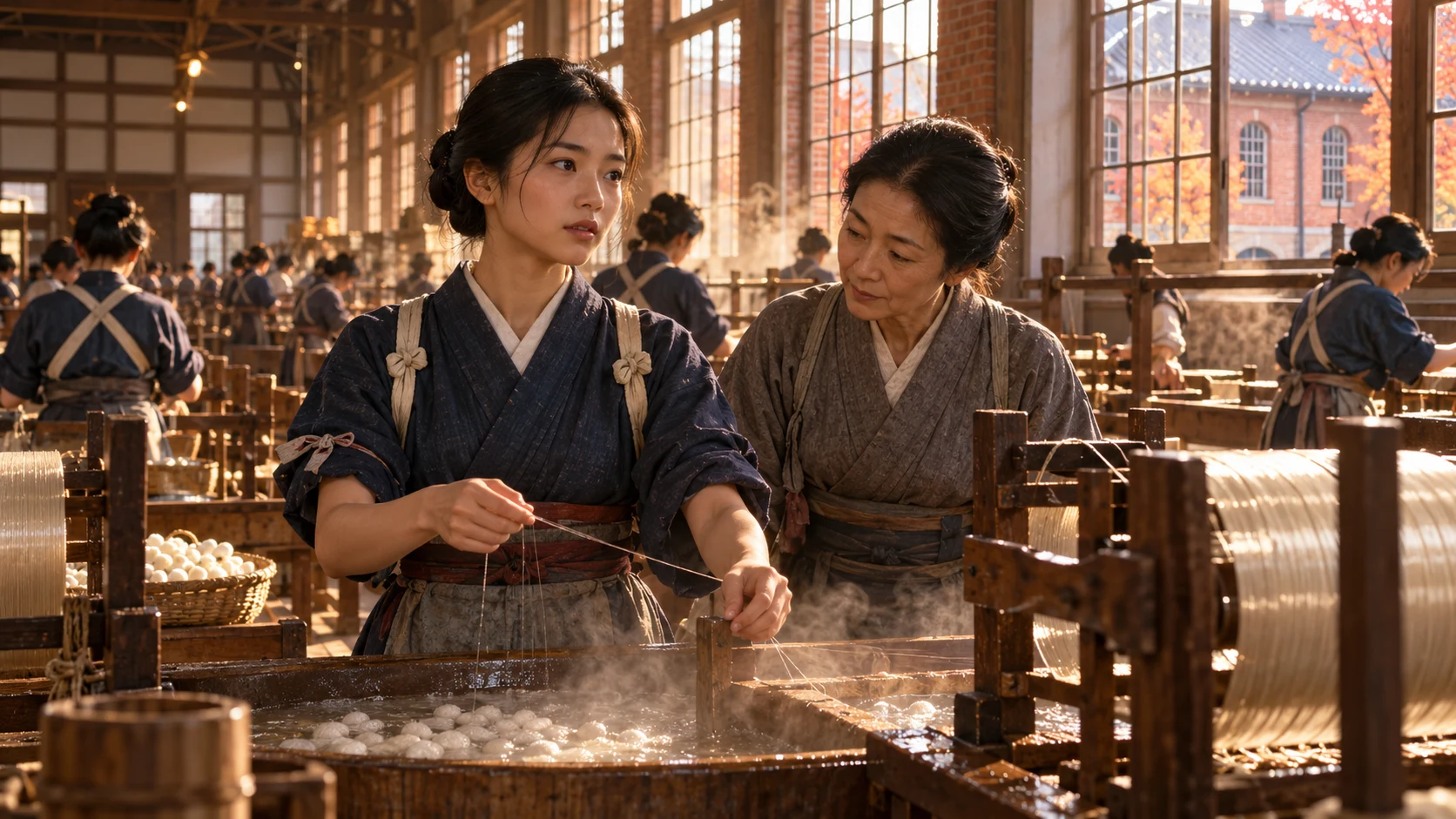
1872 · Tomioka Silk Mill starts operating
Reeling silk and sharing skills at Tomioka
Women at a government mill helped spread mechanised silk-reeling skills.
Cocoons, the mill and the spread of skills
Is installing machinery enough to change silk production elsewhere?
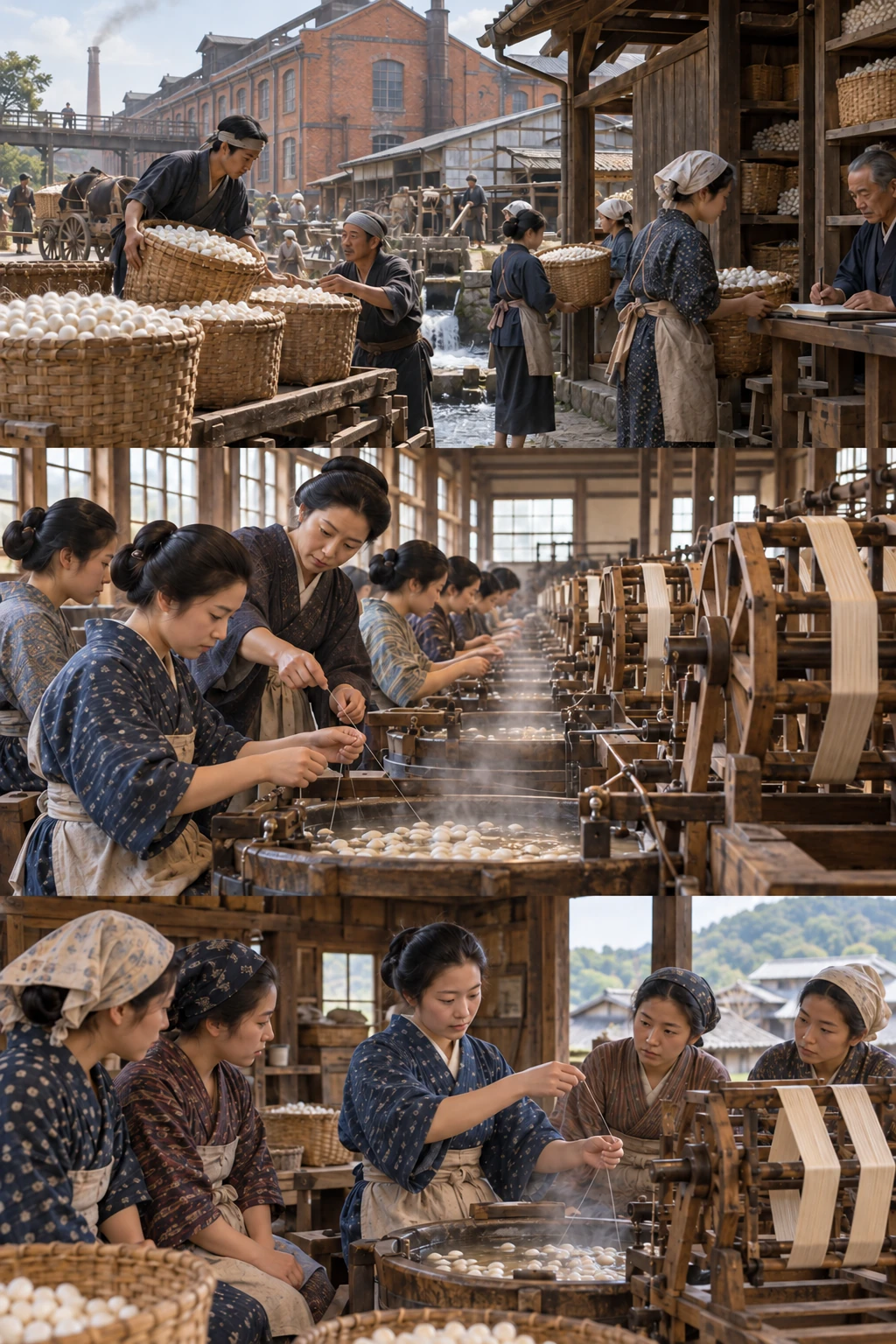
Materials and water feed into mechanical production.
Raw materials and quality support exports
Rising raw-silk exports made quality improvement important. Cocoon supply and water affected the mill’s location; machines required supporting conditions.
Sources and scope
These illustrations explain processes and institutions rather than reconstructing actual people, buildings or layouts. Cutaways and insets show hidden structures or separate locations.
History of Tomioka Silk Mill ↗Responding to demand and quality problems
Raw silk became an important export after the ports opened, but poor-quality thread also circulated as output expanded. The government wanted Tomioka to spread methods for consistent quality, not merely produce more. Planned in 1870 and operating from 1872, it employed women who were also expected to learn and transmit skills.
The surrounding sericulture, water supply and transport to Yokohama informed the choice of Tomioka. Japanese tile makers also helped produce bricks for construction. Imported machinery required local raw materials, water and builders; the mill joined foreign techniques with regional production and domestic crafts.
Reeling silk and learning skills
Workers recruited from different regions learned through reeling. Handling cocoons and equipment required skill; machinery did not independently guarantee quality. Production doubled as training, preparing workers to take techniques elsewhere.
Operations continued with Japanese staff after foreign instructors left in 1876. Sustained use required people to practise and pass on knowledge. The model mill’s role lay in developing operators and instructors, not only installing imported equipment.
Sericulture, factories and markets
Before reeling came silkworm raising and cocoon supply. Related heritage sites preserve egg storage and sericultural teaching. Expanding output depended on reliable material as well as machinery, placing the mill within a wider production system.
Private ownership from 1893 was followed by changing management and equipment until operation ended in 1987. State training, commercial production and later preservation were different phases. The mill’s long history cannot be represented solely by its founding moment.
Before and after
- 1872
The state-built mill begins operation.
- 1893
The mill transfers to private ownership.
- 1987
Operation ends.
Key terms
- Raw silk
- Silk reeled from cocoons, an important export.
- State-operated
- Government operation, distinct from importing foreign expertise.
- Silkworm eggs
- Eggs used to rear silkworms.
What supports the account?
The mill combined production with technical training.
The official account describes women’s training and return to their regions.
Wada Ei’s experience cannot stand for every worker.
Several facilities supported the industry.
The heritage account links farming, egg storage and reeling.
The mill did not independently complete every stage.
Check your understanding
Choose an answer to reveal the explanation. Return to the article and sources when you are unsure.
Sources
- Understanding Tomioka Silk Mill富岡市
Purpose, location, opening, training, Wada Ei and operational history.
- Tomioka Silk Mill and Related SitesUNESCO世界遺産センター
The connected sites for reeling, sericulture, education and egg storage.
Keep exploring
1889 · Promulgation of the Meiji Constitution
What the Meiji Constitution established
Original documents explain the emperor, parliament and subjects’ rights.
Tokyo
1900 · Opening Joshi Eigaku Juku
The school Tsuda Umeko began with ten students
After overseas study, creating opportunities at home connected higher education to work.
Kōjimachi, Tokyo
Early nineteenth century · Late Edo urban life
Water and commerce in everyday Edo
Look beyond individual homes to the systems supporting a large city.
Edo, present-day Tokyo