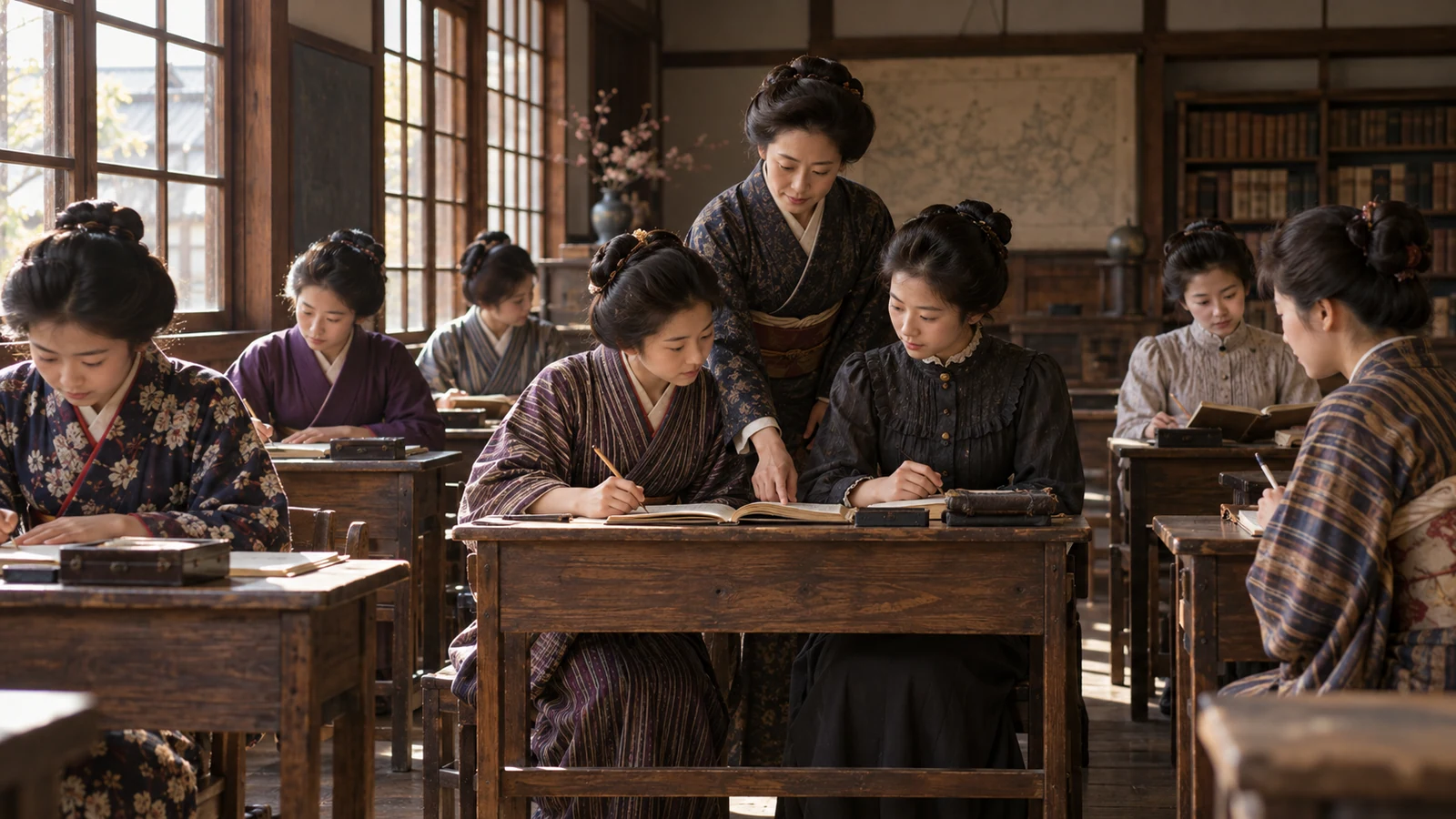
1900 · Opening Joshi Eigaku Juku
The school Tsuda Umeko began with ten students
After overseas study, creating opportunities at home connected higher education to work.
From overseas study to a school in Japan
Tsuda’s school opened with ten students in 1900. Its 1905 authorisation for English-teacher qualification connected specialist study with employment. Umeko had left Japan at six, returned in 1882, taught and studied abroad again. Founding the school followed experience of both learning and working after her return.
Sutematsu Ōyama, Shigeko Uryū and Alice Bacon supported the opening; Bacon helped with admission and class placement. Founding required practical organisation of students, teachers and lessons, not merely naming a building. The familiar founder’s name encompasses shared institutional work.
Advanced education beginning with ten students
The school opened at Kōjimachi with ten students in 1900. Individual teaching and students’ active study mattered alongside English expertise and broader education. Small enrolment did not imply elementary instruction. Size, level and educational purpose are distinct characteristics.
Permission in 1905 connected study to English teaching qualifications. A university account also presents a 1918 map of graduates’ posts, mainly at girls’ secondary schools. Qualifications and employment records show how learning reached other classrooms beyond statements of purpose.
Continuing after the campus was lost
The Gobanchō campus burned after the 1923 earthquake, and classes resumed in temporary premises in January 1924. Loss of buildings did not permanently end education. Continued teaching depended on re-establishing both space and organisation.
After Umeko’s death the school moved to Kodaira in 1931. The original ten were not permanent total enrolment, and one school did not equalise access for every woman. Its significance lies in establishing and sustaining particular opportunities rather than claiming instant universal transformation.
After the earthquake, teacher Hartshorne raised funds in America. Reopening needed funds, materials and space, demonstrating international support beyond the founder’s individual determination.
Graduate and teacher Ai Hoshino succeeded Umeko in 1929. Moving from learner to institutional leader connects education with its own continuity, as training supplied both external professionals and future school personnel.
Before and after
- 1871
Umeko leaves for the United States at six.
- 1900
The school opens with ten students.
- 1905
Recognition for English-teacher qualification without a separate examination.
- 1924
Classes resume after the earthquake in temporary buildings.
Key terms
- Joshi Eigaku Juku
- The women’s advanced-education institution founded in 1900.
- Broad learning
- Learning extending beyond a single speciality.
- Teaching qualification
- Certification or recognition enabling teaching work.
What supports the account?
The school opened with ten students.
The university chronology supplies the year and enrolment.
Small enrolment does not establish weak teaching.
Education became linked to professional qualification.
The chronology documents the 1905 recognition.
One school’s recognition does not prove equal access for all women.
Check your understanding
Choose an answer to reveal the explanation. Return to the article and sources when you are unsure.
Sources
- History of Tsuda University津田塾大学
Overseas study, return, educational aims and founding.
- Tsuda University chronology津田塾大学
Ten students in 1900, teaching qualification in 1905 and earthquake damage in 1923.