1896–1911
How the Curies established new elements
From measuring radiation to separation and testing a hypothesis.
From ore measurements to a hypothesis
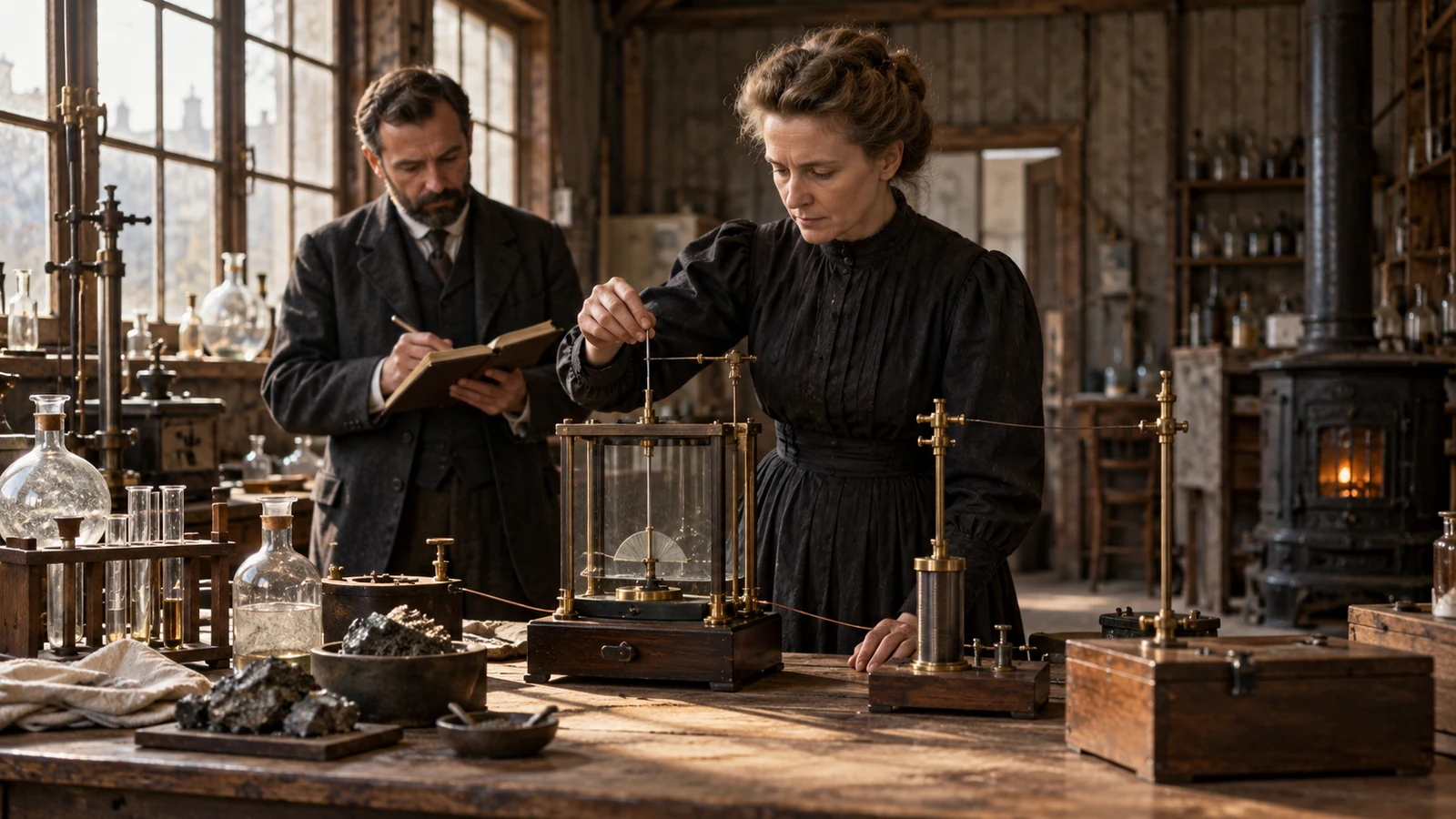
Building on Becquerel’s 1896 work, Marie Curie measured activity electrically. Ore produced more activity than its uranium explained, suggesting an unknown substance. This discrepancy did not identify an element or its quantity: separation and repeated measurement were still required.
Following separation through measurement
Separating material, measuring activity and separating the active portion again built evidence. The 1898 announcements, purification of radium chloride and isolation of metallic radium with Debierne were distinct stages. Chemical form and purity required work beyond an activity reading.
Sharing discovery and verification
The physics prize of 1903 and chemistry prize of 1911 concern different stages. Pierre’s 1905 lecture also discusses Rutherford and Debierne, revealing work across measurement, separation, theory and standard samples. Prize names alone conceal these contributions. Health damage should not be romanticized as proof of devotion.
Before and after
- 1896
Becquerel discovered uranium radiation.
- 1898
Polonium and radium were reported.
- 1903
Becquerel, Pierre and Marie shared the physics prize.
- 11 December 1911
The chemistry Nobel lecture.
Key terms
- Hypothesis
- A testable proposed explanation for observations.
- Chemical separation
- Dividing substances according to differences in properties.
- Radioactivity
- The property of spontaneously emitting radiation.
What supports the account?
Strong radiation was a starting point, not a completed proof. Separating fractions and measuring them repeatedly tested possible explanations.
Her account of measurement, separation, properties and collaborative research. The hypothesis, discoveries of 1898 and collaboration.
Do not assume researchers possessed all later knowledge.
Measurements after separation traced where activity concentrated. Quantitative and chemical work together established properties.
Her account of measurement, separation, properties and collaborative research. The hypothesis, discoveries of 1898 and collaboration.
Reporting a discovery and isolating a pure material are different stages.
Check your understanding
Choose an answer to reveal the explanation. Return to the article and sources when you are unsure.
Sources
- Marie Curie’s Nobel lecture, 1911Nobel Prize Outreach
Her account of measurement, separation, properties and collaborative research.
- Marie Curie: Questions and answersNobel Prize Outreach
The hypothesis, discoveries of 1898 and collaboration.
- Marie and Pierre Curie and the discovery of polonium and radiumNobel Prize Outreach
Working conditions, health burdens and collaborative history.
- Measurement, isolation and collaborationNobel Prize Outreach
Activity in bismuth- and barium-bearing fractions, radium chloride and metal isolation, and collaboration.
- Pierre Curie’s lecture of 1905Nobel Prize Outreach
His account of radioactivity and contributions by other researchers.
Keep exploring

1804–1815
Napoleon’s Civil Code and Empire
In 1804, a Civil Code and an emperor reshaped institutions and authority after the Revolution.
Paris
1989–1990
The night the Berlin Wall opened
From a press conference to border crossings: the opening and reunification were distinct events.
BerlinLate eighteenth–early nineteenth centuries
Steam engines and working lives
Powering factories also changed working hours and children’s lives.
Industrial Britain