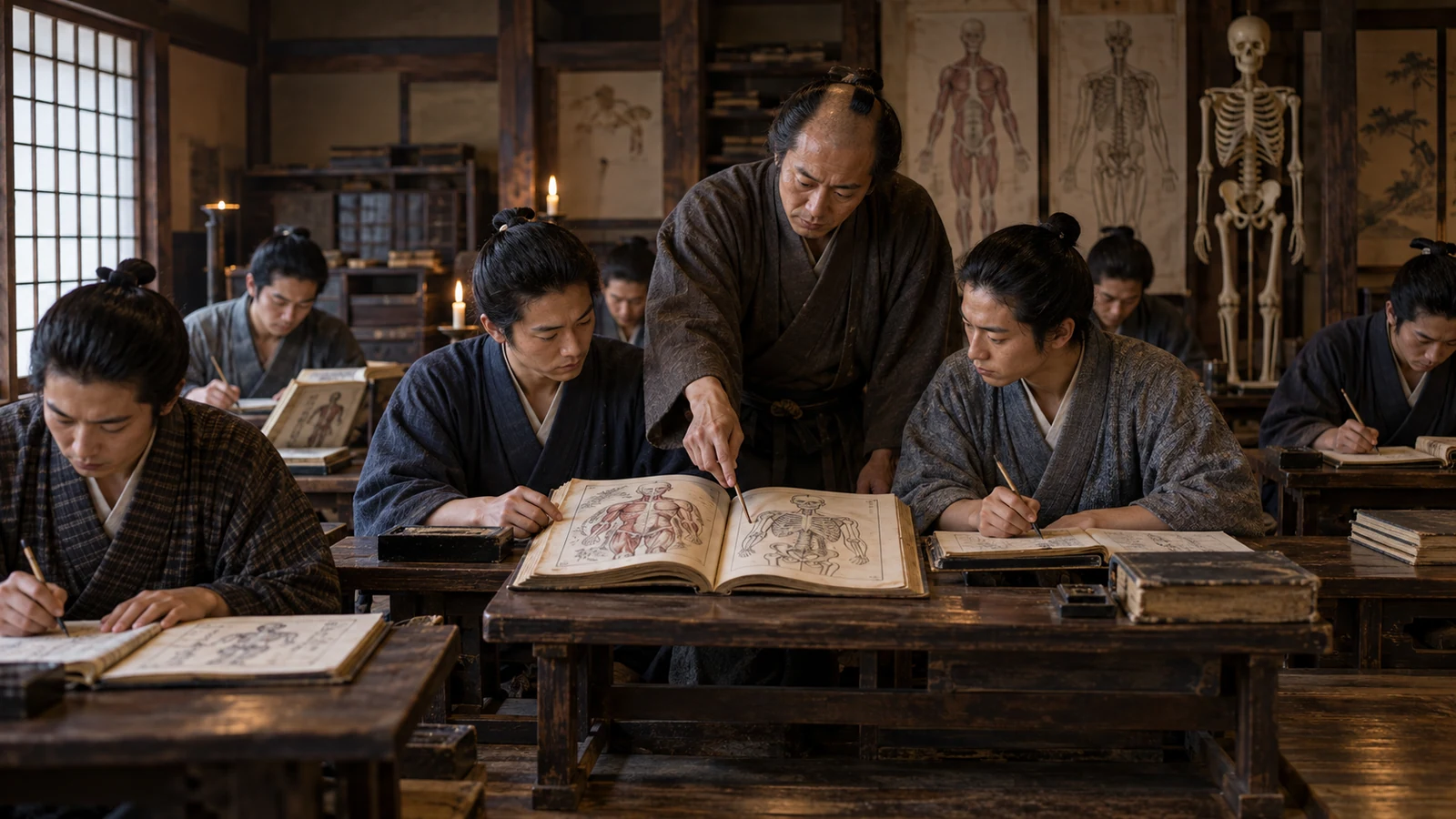
1838–1862 · Ogata Kōan and Tekijuku
Reading medicine at Tekijuku and treating the town
Students reading Dutch texts and doctors addressing disease connected learning to public life.
A school connected with medical practice
Kōan’s school, opened in 1838, stood alongside his clinic. Reading Dutch medicine required checking, Japanese publication and communication to practitioners before knowledge could reach patients. Establishing the vaccination centre in 1849 and publishing during the 1858 cholera epidemic were different attempts to carry learning beyond the classroom.
Byōgaku Tsūron involved revising inherited work through original and related books. Producing a Japanese medical text required decisions about additions and corrections, not simply translating one volume straight through. Sources, inherited scholarship and editorial work contributed distinct roles.
Prevention and response concern different diseases
Kōan and colleagues opened Jotōkan in 1849 for smallpox vaccination. Prevention differs from treating an existing illness. Establishing a service and issuing documents such as vaccination licences connected knowledge with practitioners and communities.
During the 1858 cholera outbreak Kōan rapidly published a treatment guide. This concerned a different disease and purpose from smallpox prevention. Reading, publishing and practice show the social work of learning, without publication proving effective care reached every patient.
Students carry knowledge into regional practice
Famous political careers can overshadow former students providing regional care and vaccination. Institutional influence is not measured only by celebrity. Movements and work identify routes of knowledge transfer, showing that learning could serve different careers.
Family and students maintained the school after Kōan was summoned to Edo in 1862. His departure did not terminate teaching. Later continuity involved people and institutions, not merely changing a name, extending the history into translation, preventive services and regional work.
An 1859 graded list records eighty-one students at that date, with no members in its highest two grades. It is a snapshot rather than total historical enrolment, documenting differentiation of learning stages.
Ikuzō Ogata and others participated in translating Fushi Keiken Ikun, with publication following completion later. Translation, editing, printing and regional use formed separate tasks behind a familiar authorial name.
Before and after
- 1838
Clinic and Tekijuku open in Osaka.
- 1849
A vaccination institution opens.
- 1858
Vaccination receives authorisation and a cholera handbook is published.
- 1862
Kōan leaves for Edo at the shogunate’s summons.
Key terms
- Dutch learning
- Study of Western knowledge through Dutch-language materials.
- Smallpox vaccination
- Vaccination intended to prevent smallpox.
- Student or disciple
- A person studying under a teacher.
What supports the account?
Tekijuku’s significance includes regional care.
The university describes returning doctors and vaccination.
Do not define its outcomes only through famous politicians.
Teaching continued after Kōan moved to Edo.
Histories record family, students and later institutions.
Do not explain the university lineage as a name change alone.
Check your understanding
Choose an answer to reveal the explanation. Return to the article and sources when you are unsure.
Sources
- History of Tekijuku大阪大学
Founding in 1838, medicine, Dutch studies, students and continuity.
- About Tekijuku大阪大学 適塾記念センター
Vaccination, cholera and students providing regional care.
- Tekijuku chronology大阪大学
Founding, the 1862 summons and later educational and medical institutions.
- Collection introduction大阪大学 適塾記念センター
Translation, vaccination, the 1858 cholera handbook and authorisation, and the 1859 graded list.
Keep exploring
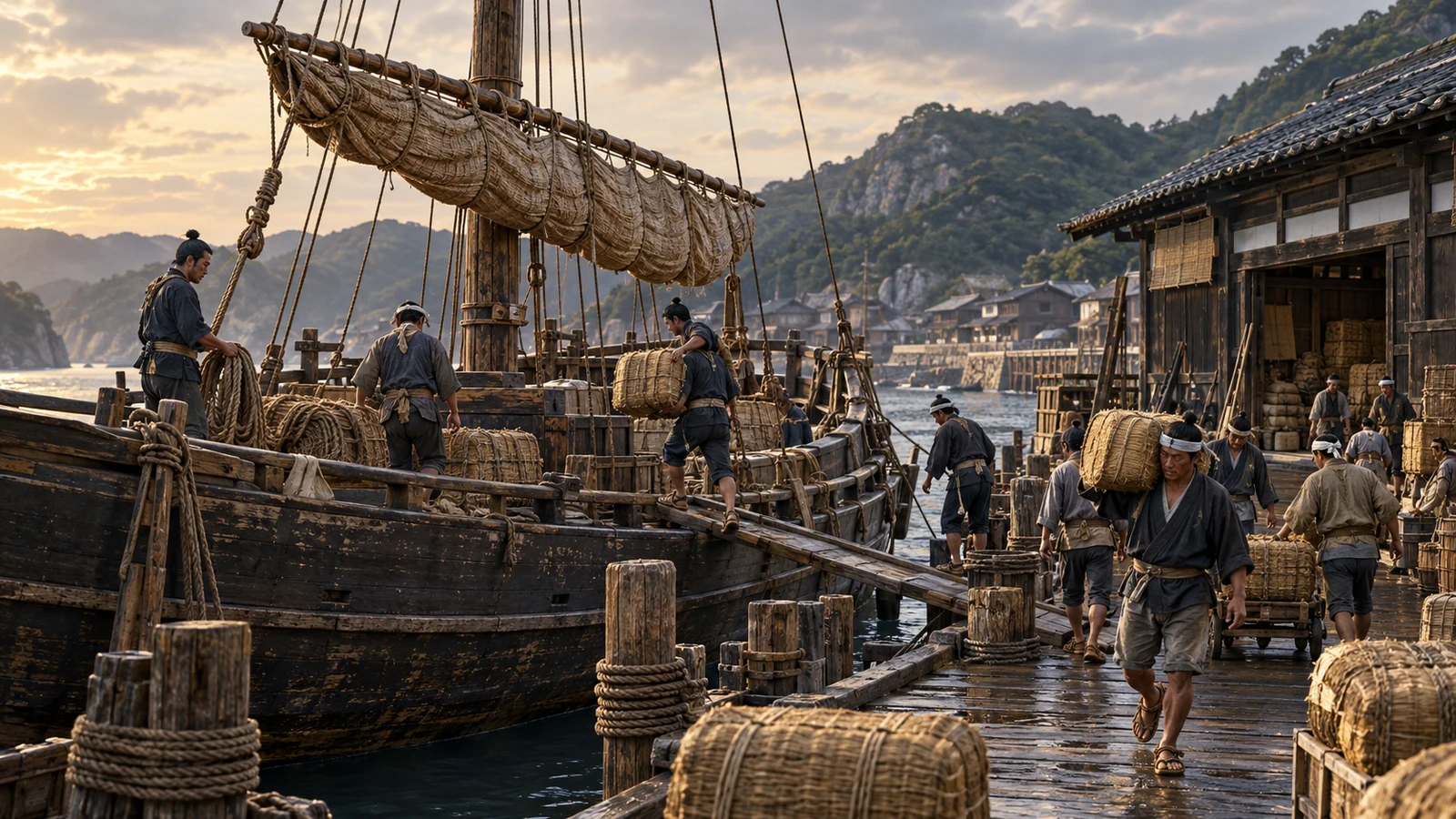
Eighteenth century–mid-Meiji · Sea of Japan routes
Trading at each port aboard a kitamae ship
Rice, kelp, herring and used clothes: voyages profited from trading, not only freight.
Hashitate, Ishikawa / Ishikari, Hokkaidō / Osaka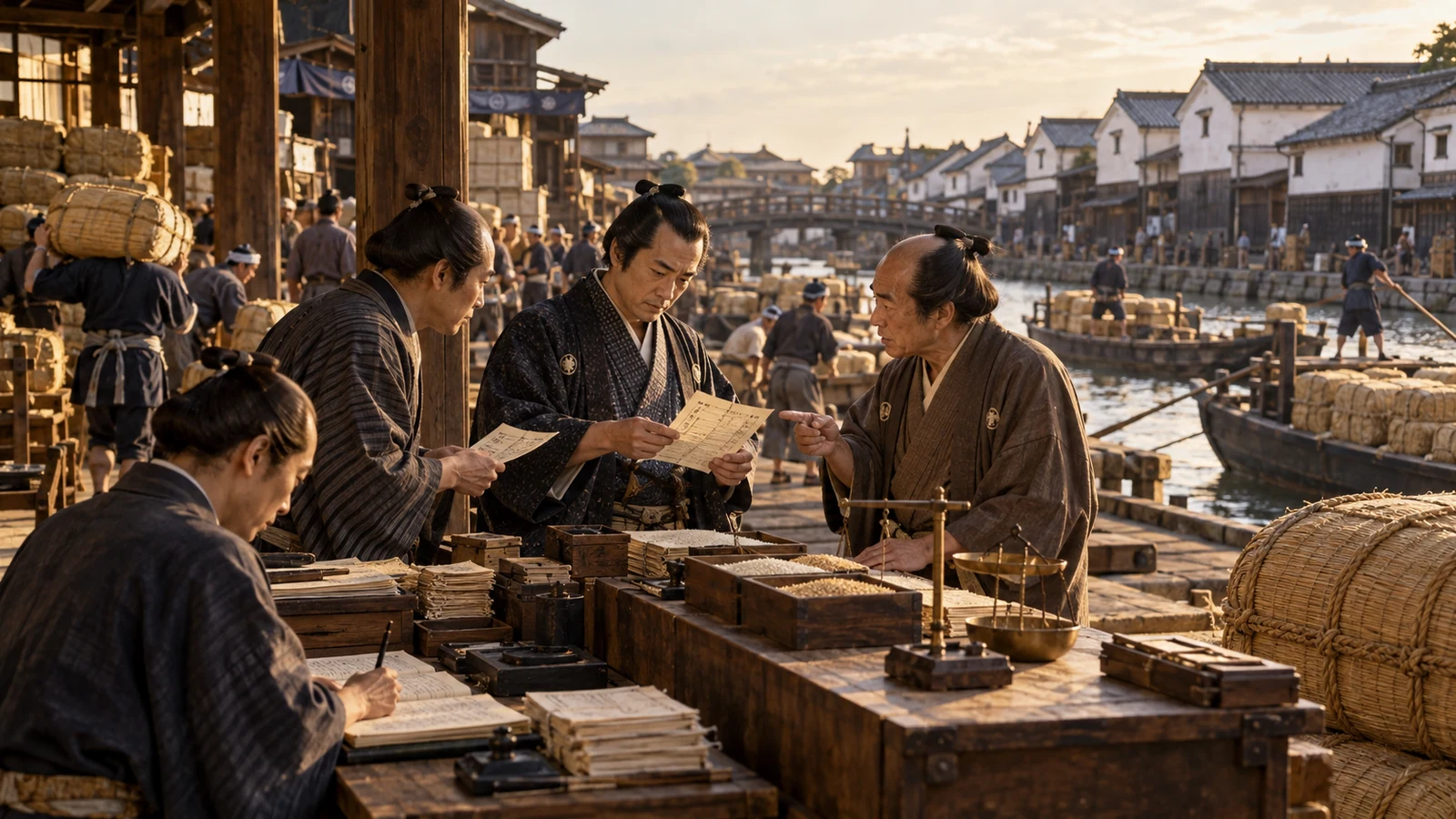
1730–1869 · Dōjima rice market
Setting prices in a city receiving rice
Domain warehouses, rice receipts and contracts connected rice to money in Osaka.
Dōjima, Osaka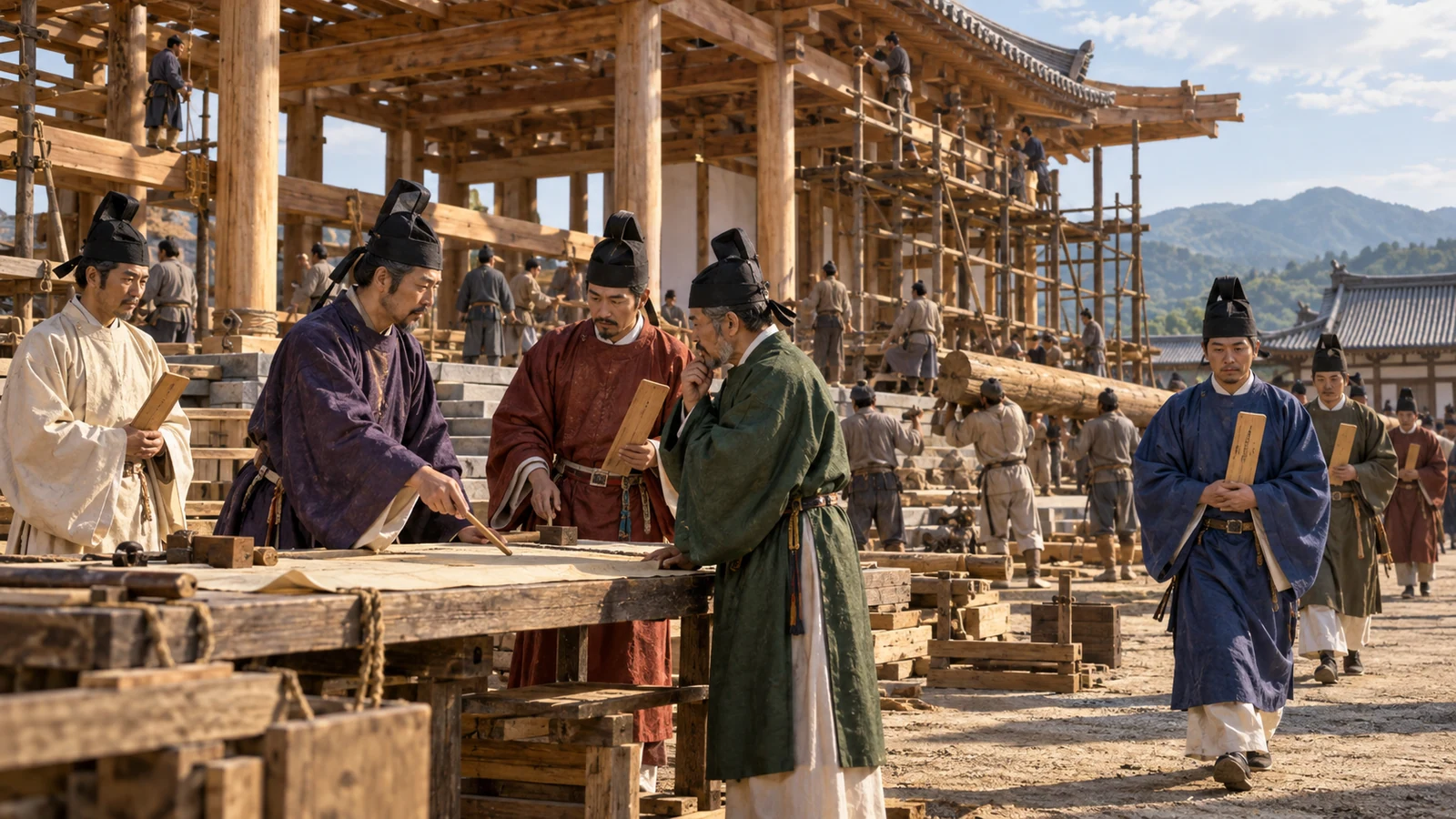
645–701 · From coup to legal codes
The Taika reforms were not a single-day change
Separate the assassination of Soga no Iruka from the later formation of state institutions.
Asuka, Nara / Naniwa, Osaka