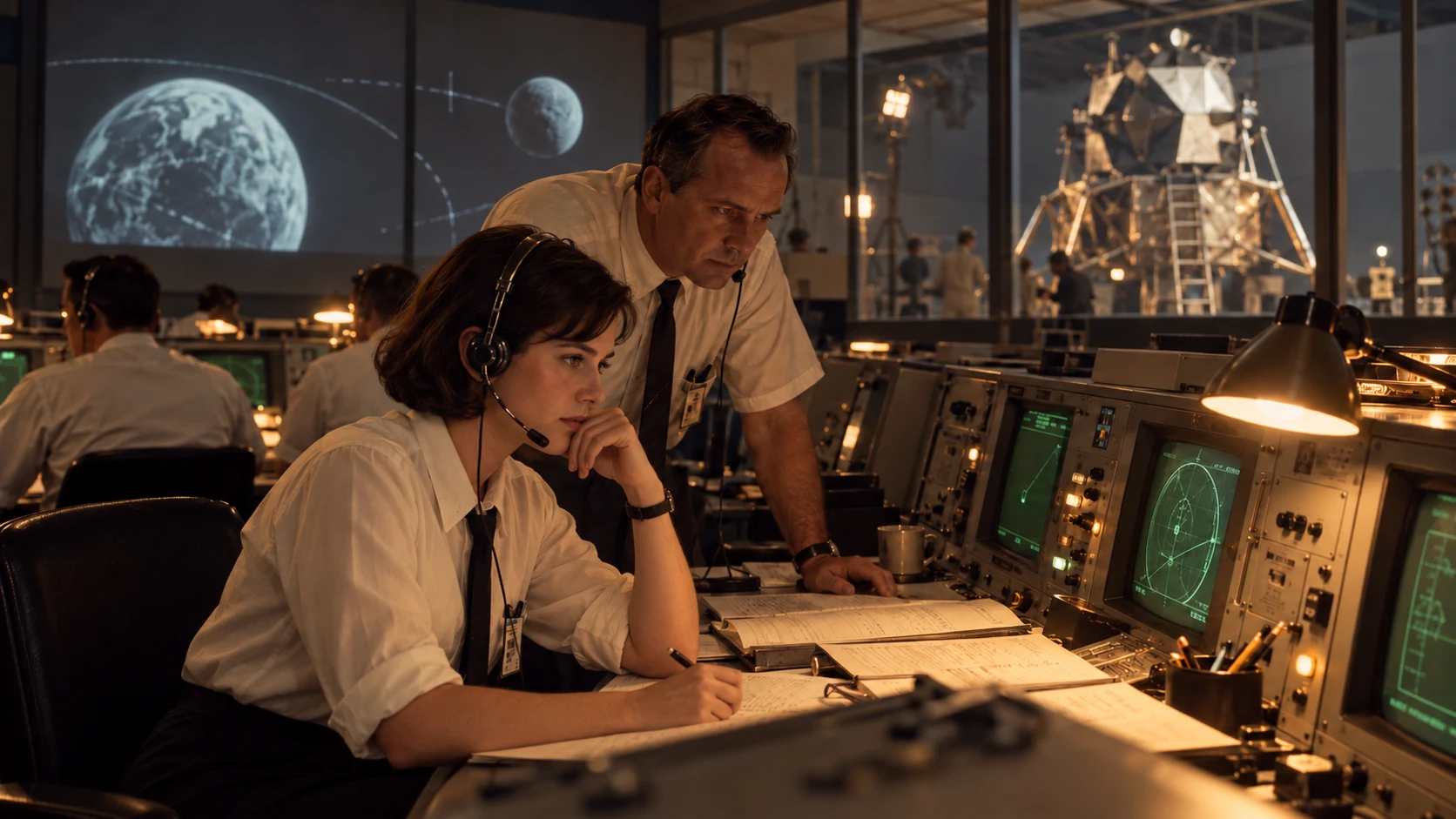
July 1969
Apollo 11: reaching the Moon and returning
Two astronauts on the surface and one in orbit: landing was only part of the mission.
Two descend while one remains in orbit
Did the landing craft return directly from the Moon to Earth?
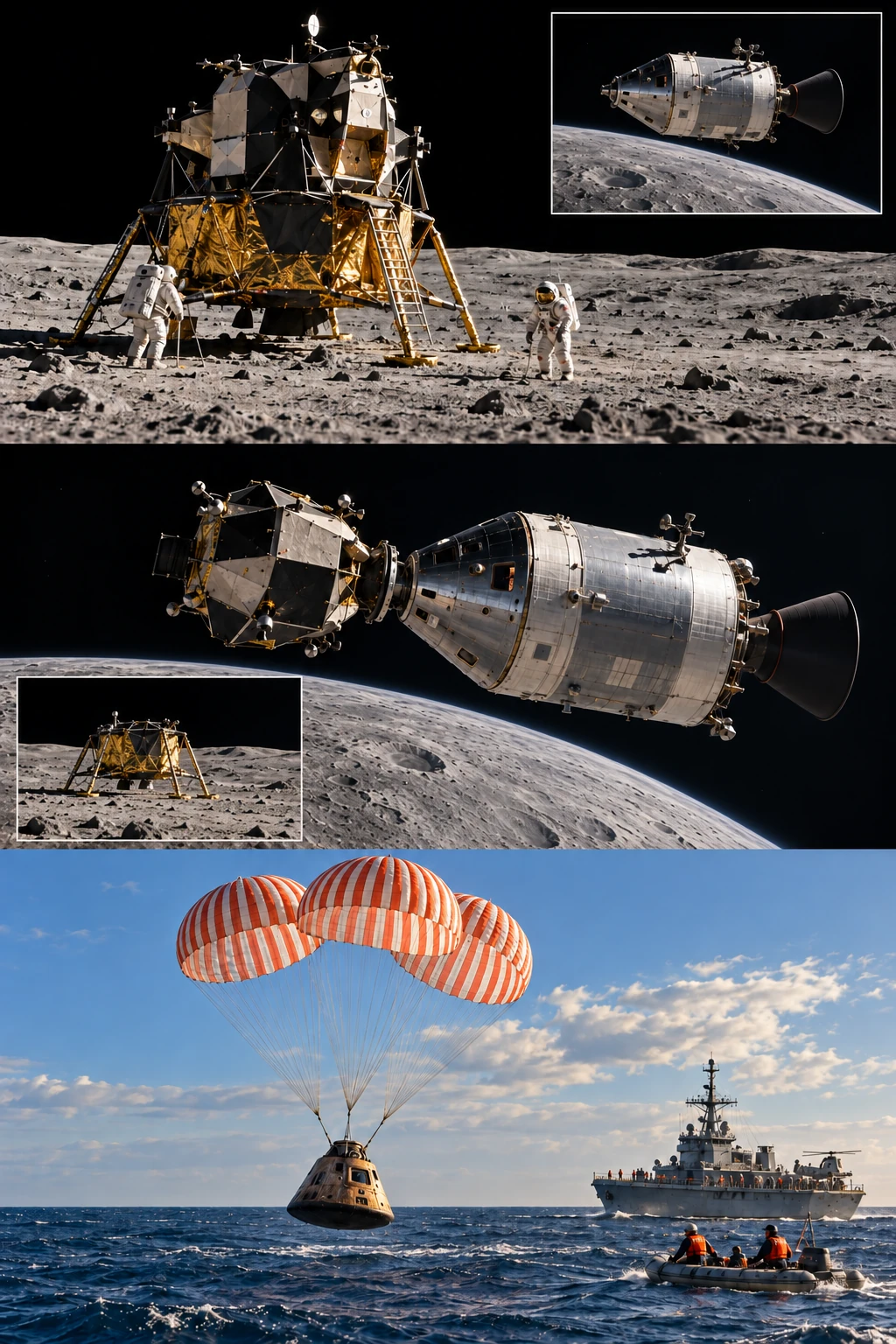
Lunar and command modules occupy different places.
Two on the surface; one in orbit
Armstrong and Aldrin descended in Eagle; Collins remained in Columbia. The landing depended on the role waiting in orbit as well.
Sources and scope
These illustrations explain processes and institutions rather than reconstructing actual people, buildings or layouts. Cutaways and insets show hidden structures or separate locations.
Apollo 11 mission overview ↗The goal of landing and return
Separating landing and return spacecraft meant the lunar crew had to launch again and meet a ship in orbit. Apollo 11’s journey therefore depended on rendezvous and return, not just the first step.
Two spacecraft and three roles
Armstrong and Aldrin landed Eagle while Collins operated Columbia in lunar orbit. The surface crew collected rocks and soil and recorded their locations. Seismic observation, a solar-wind experiment and a laser-ranging reflector added scientific tasks to their brief stay.
Returning samples and observations
Return required lunar ascent, rendezvous and docking with the command module. Crew and samples transferred before the Earth-bound trajectory and service-module separation. The command module reentered heat-shield first and slowed under parachutes. Pacific splashdown on 24 July ended the flight, not the study of its samples.
Apollo 11 samples identified the dark maria as volcanic lava that solidified over 3.6 billion years ago. White highland fragments in the soil, considered with Surveyor 7 chemistry, suggested an early, largely molten Moon covered by a magma ocean. Returned rocks provided evidence of lunar volcanism and melting, rather than souvenirs alone.
Before and after
- 25 May 1961
The goal of a crewed landing and return was announced.
- 16 July 1969
Apollo 11 launched.
- 20 July 1969, US date
Lunar landing.
- 24 July 1969
The three crew members returned to Earth.
Key terms
- Command module
- The spacecraft supporting lunar orbit and return.
- Lunar module
- The vehicle for lunar descent and ascent.
- Sample
- Material such as rock or soil collected for study.
What supports the account?
Collins did not land but operated the orbiting command module. Roles absent from surface photographs remain essential.
The July 1969 flight, landing, orbital support, sample collection and return. The first crewed lunar landing and its three-person crew.
Surface photographs do not depict everyone supporting the mission.
Photography, instruments and sample collection used limited time. Footprints alone obscure scientific work on returned material.
The July 1969 flight, landing, orbital support, sample collection and return. The first crewed lunar landing and its three-person crew.
Collected material does not establish all lunar geology.
Check your understanding
Choose an answer to reveal the explanation. Return to the article and sources when you are unsure.
Sources
- Apollo 11 Mission OverviewNASA
The July 1969 flight, landing, orbital support, sample collection and return.
- Apollo 11NASA
The first crewed lunar landing and its three-person crew.
- What lunar samples revealedNASA / Lunar and Planetary Institute
Apollo: The Humans Follow: Apollo 11 volcanic lavas older than 3.6 billion years, white highland fragments with Surveyor 7 analysis, and the early magma-ocean hypothesis only.
Keep exploring
April 1912
Titanic and the systems of safety
Technical achievement and inadequate preparation meet in the voyage and inquiry records.
North Atlantic route
From the second century BCE through the medieval period
The Silk Roads were a network
Goods, languages and skills moved through connected land and sea routes.
Eurasian and Indian Ocean trade networks1964 · Tokyo’s Games and a changing city
Tokyo 1964 beyond the stadium
Games, Paralympics and transport changes appear together in contemporary photographs.
Tokyo