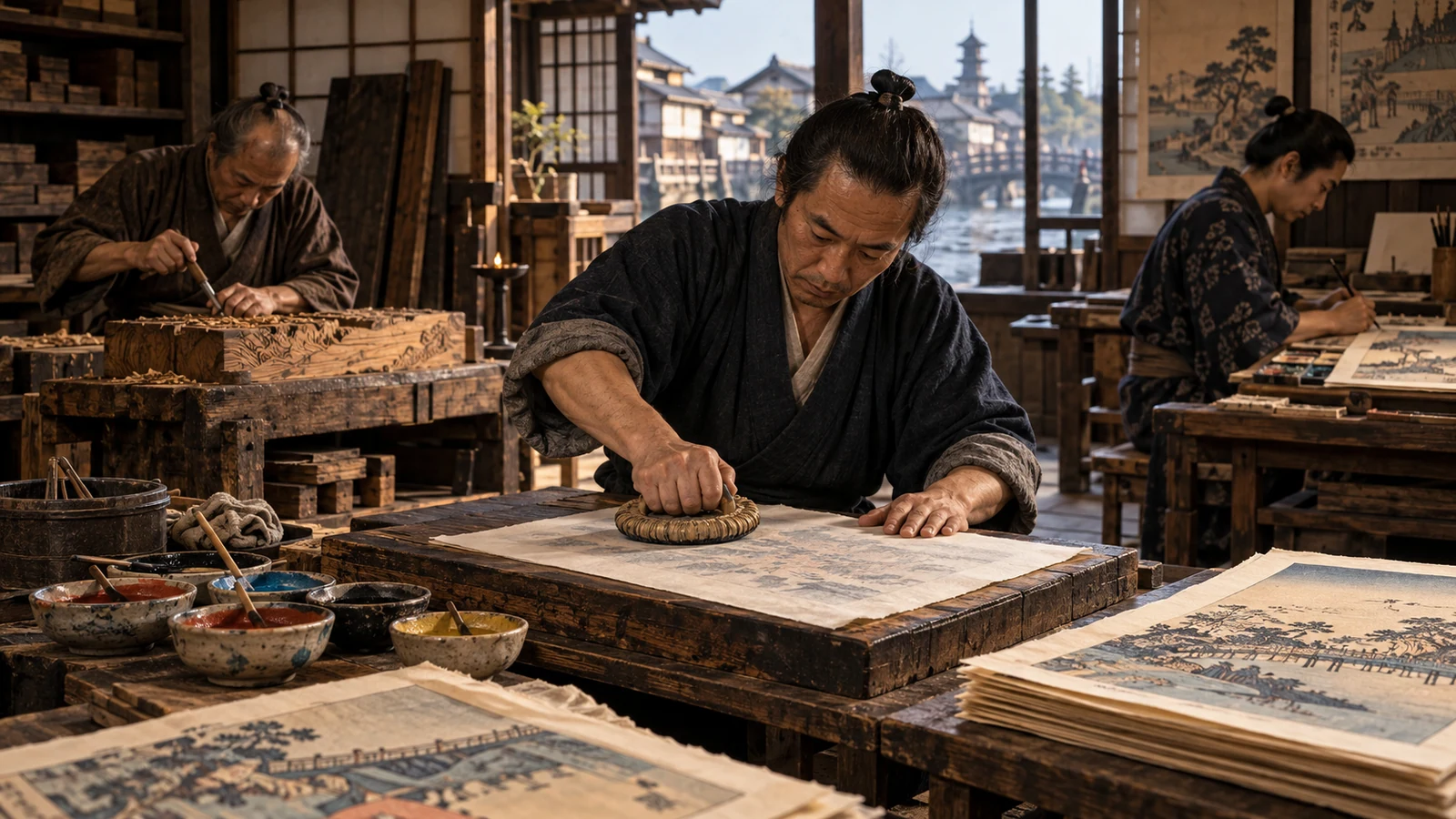
1765–early nineteenth century · Colour woodblock printing
Four professions behind a woodblock print
Publisher, designer, carver and printer: a celebrated artist’s print depended on a team.
How separate colours become one print
Why does placing one sheet on different blocks require guides?
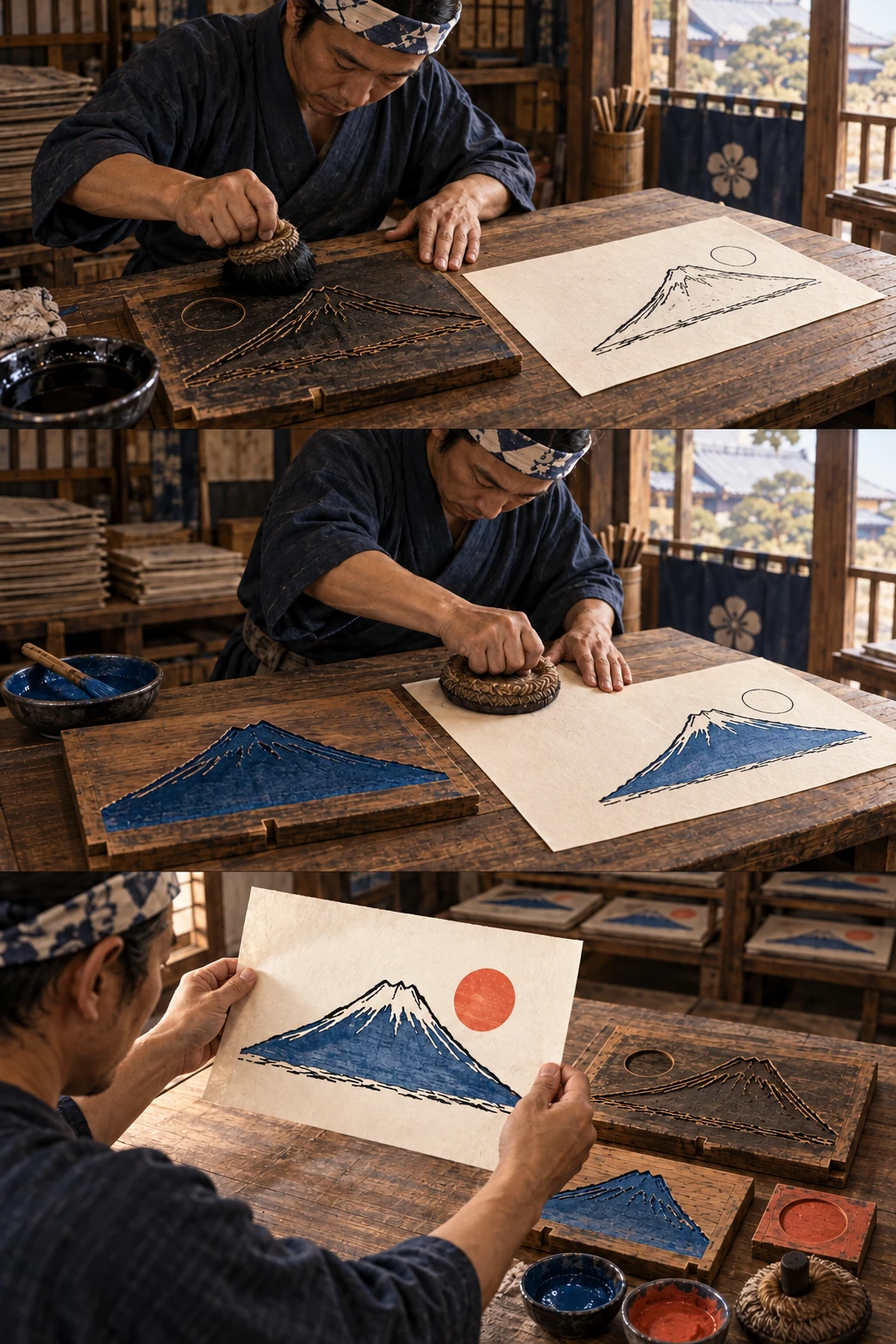
Contours appear; the colour blocks have not yet been used.
The line block establishes the design
Pigment transfers from the raised surface left by carving. Translating a drawing into wood makes the carver’s skill part of the result.
Sources and scope
These illustrations explain processes and institutions rather than reconstructing actual people, buildings or layouts. Cutaways and insets show hidden structures or separate locations.
Ukiyo-e print encyclopedia ↗From one image to a reproducible product
Paintings were drawn directly on paper or silk; prints transferred an image from blocks. Repeated impressions made several products from a design. A publisher organised the project, a designer drew it, and carvers and printers prepared reproducible impressions. The designer’s signature does not mean that person drew each printed line by hand.
Prints also appeared on fans and advertising. A museum frame can obscure their life as things bought, used and carried home. Designs belonged to a relationship between publishers and buyers as well as individual invention. Reaching an audience connected the separate crafts into one product.
Aligning separate blocks
The outline block and colour blocks were applied successively. Misalignment separated colour from outlines, so registration marks positioned the paper consistently. Multicolour printing required repeatable placement, not merely more pigments. Carving and printing met at the precise relationship between block and paper.
Different impressions can vary in line and colour. Ota’s comparisons show early and later printing, while marginal registration traces and publisher seals identify production. Edges and small marks reveal a commercial history beyond the central image. Differences require examination of printing and preservation rather than immediate rejection as forgery.
Registration advanced limited-colour printing around 1741–1744; calendar exchanges around 1765 accompanied further multicolour development. Technical changes unfolded through stages and specific demand.
Formats related to dividing larger paper sheets economically. Composition fitted commercial use of materials, making size a production condition rather than merely a later framing choice.
From purchase to a museum collection
A publisher seal concerns publication; an ownership mark concerns later custody. One sheet can carry traces of production, sale and collecting from different dates. Its present colour alone cannot recreate the original shop, but seals and margins help trace passage between owners.
Photography and newspapers expanded information roles in Meiji, changing the place of prints without immediately erasing woodblock technique. Everyday use, image reproduction and later artistic evaluation belong to different histories. Even a single wave image therefore opens onto publishing, craft and preservation.
Before and after
- c. 1741–1744
Registration advances printing with several colours.
- c. 1765
Multicolour printing develops substantially.
- Early nineteenth century
Period of publication of Hokusai’s Fuji series.
- Meiji period
Photography and newspapers expand their information roles.
Key terms
- Publisher
- A person organising publication, production and sales.
- Registration mark
- A mark positioning paper consistently on a block.
- Painting and print
- An image painted directly versus one printed from a block.
What supports the account?
Several specialised professions made a print.
The museum explains design, carving and printing.
A signature does not identify the designer as every worker.
Outline colour can vary within a series.
The Fuji exhibition distinguishes blue and black outlines.
One impression does not define every copy’s colour.
Check your understanding
Choose an answer to reveal the explanation. Return to the article and sources when you are unsure.
Sources
- Encyclopedia of ukiyo-e woodblock printingすみだ北斎美術館
Colour printing around 1765, divided labour, blocks and printing.
- Hokusai and Fuji exhibitionすみだ北斎美術館
Outline colours in Fuji series, carvers and illustrated books.
- Looking closely at ukiyo-e太田記念美術館
Registration marks, publisher seals and ownership marks.
Keep exploring

1800–1821 · Surveying and completing maps
How were the Inō maps measured and made?
Measured routes, recorded bearings and observed stars lay behind a team’s mapping work.
Sawara, Chiba / Fukagawa, Tokyo1889 · Promulgation of the Meiji Constitution
What the Meiji Constitution established
Original documents explain the emperor, parliament and subjects’ rights.
Tokyo
1900 · Opening Joshi Eigaku Juku
The school Tsuda Umeko began with ten students
After overseas study, creating opportunities at home connected higher education to work.
Kōjimachi, Tokyo