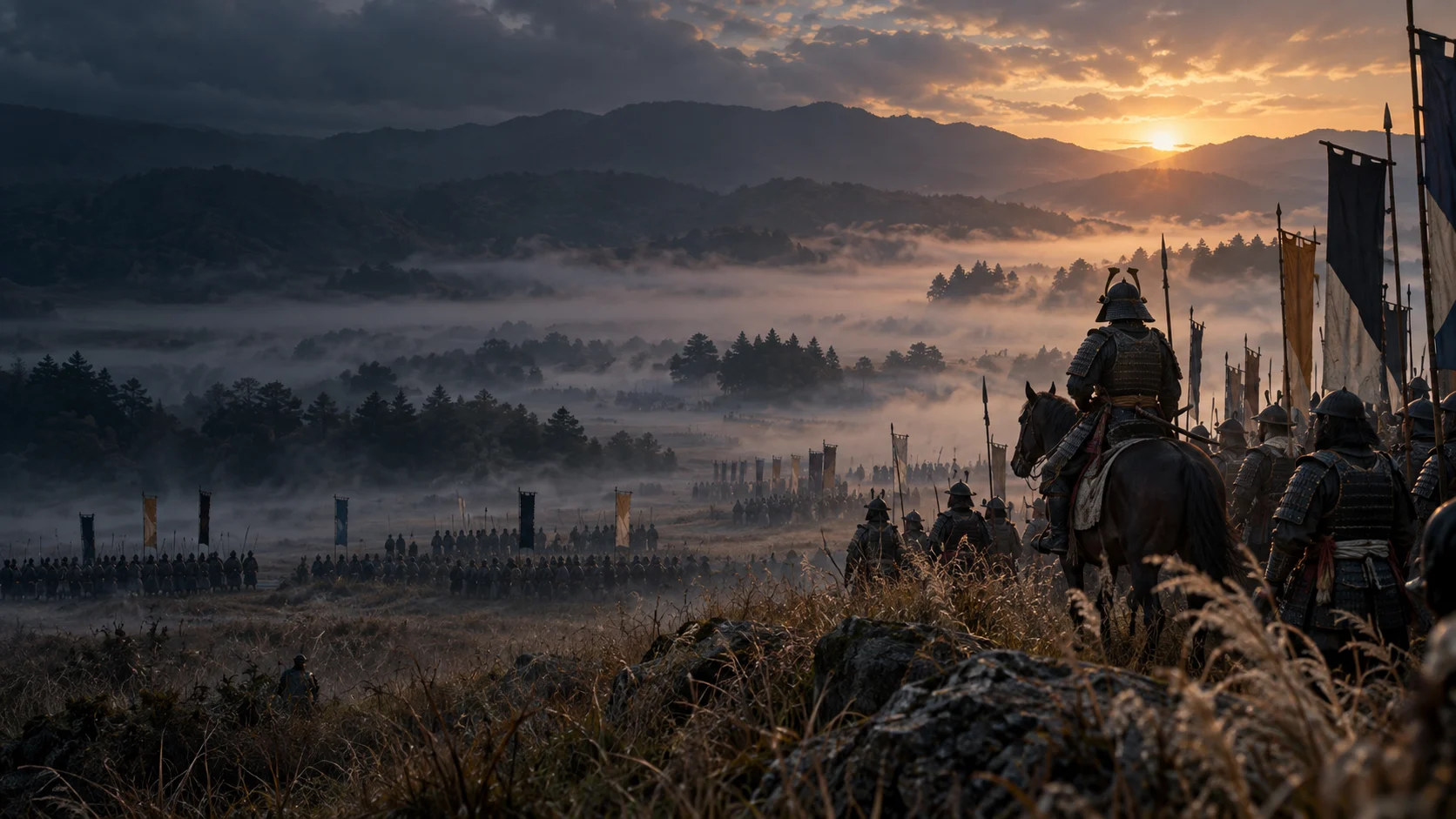
1600 · Fifteenth day of the ninth lunar month
Reading Sekigahara through its records
Separate the battle’s date from the later stories told about it.
Conflict after Hideyoshi’s death
Hideyoshi’s death in 1598 did not end the Toyotomi house. Powerful figures within its political order divided, leading to the eastern and western armies of 1600. Each participating lord had territories and relationships to protect. These affiliations cannot be understood simply by splitting a modern map into two countries.
Routes and terrain channelled movement into Sekigahara. Troops and supplies came from wider territories. With several lords’ forces involved, cooperation and changing alliances mattered alongside individual battlefield skill.
Turning victory into territorial authority
Eastern victory on the lunar ninth month’s fifteenth day strengthened Ieyasu. Rewards and penalties reshaped lordship, affecting revenue, service and households beyond the battlefield. This translated military advantage into territorial arrangements within a longer sequence preceding appointment and later war.
Chronicles presented by the Gifu library include accounts dated 1663 and around 1720, long after the battle. Age does not establish eyewitness authorship.
The result and every command or dialogue have different evidential certainty. These texts inform the event and its later narrative transmission, with attention to when particular details appear.
Consolidation through 1603 and 1615
Ieyasu became shogun in 1603, three years after the battle. Appointment and victory were distinct. Passing the office to Hidetada in 1605 established dynastic continuity, illustrating the institutional work following military advantage.
The Toyotomi remained at Osaka after Sekigahara until the campaigns of 1614–1615. Opposition did not disappear everywhere in 1600. The sequence from battle to appointment and later war shows consolidation across separate decisions and conflicts.
Before and after
- 1598
Toyotomi Hideyoshi dies.
- 1600, ninth lunar month, day 15
Ieyasu’s side wins at Sekigahara.
- 1603
Ieyasu becomes shogun and establishes the Edo government.
- 1615
The summer Osaka campaign ends Toyotomi rule.
Key terms
- War narrative
- Writing about warfare, often compiled later.
- Contemporary source
- A source created in the period of the event.
- Calendar conversion
- Matching a day expressed in different calendar systems.
What supports the account?
The two month-day forms refer to the same battle day.
The date is provided in historical and modern calendars.
Do not compare dates without identifying their calendars.
Battle narratives contain later compilation.
The library documents when narratives were compiled.
Do not treat every narrative passage as eyewitness testimony.
Check your understanding
Choose an answer to reveal the explanation. Return to the article and sources when you are unsure.
Sources
- Gifu and Sengoku-period materials岐阜県図書館
Military narratives of Sekigahara and their composition or publication dates.
- Sekigahara and its commanders岐阜県観光連盟
Lunar and Gregorian dates and conflict after Hideyoshi’s death.
- Tokugawa Ieyasu chronology久能山東照宮
Victory in 1600, shogunal appointment in 1603, and the Osaka campaigns. This commemorative institution’s chronology is used for dates, not its praise as historical assessment.
Keep exploring
1553–1564 · Struggles over Kawanakajima
Why was Kawanakajima fought over repeatedly?
Look beyond the famous duel to local lords, rivers and castles in Shinano.
Kawanakajima, Nagano1488–1580 · The Kaga Ikkō movement
Faith and power in Kaga
From a governor’s defeat to the fall of Kanazawa Midō, trace faith and political power.
Kanazawa, Ishikawa
Eighteenth century–mid-Meiji · Sea of Japan routes
Trading at each port aboard a kitamae ship
Rice, kelp, herring and used clothes: voyages profited from trading, not only freight.
Hashitate, Ishikawa / Ishikari, Hokkaidō / Osaka