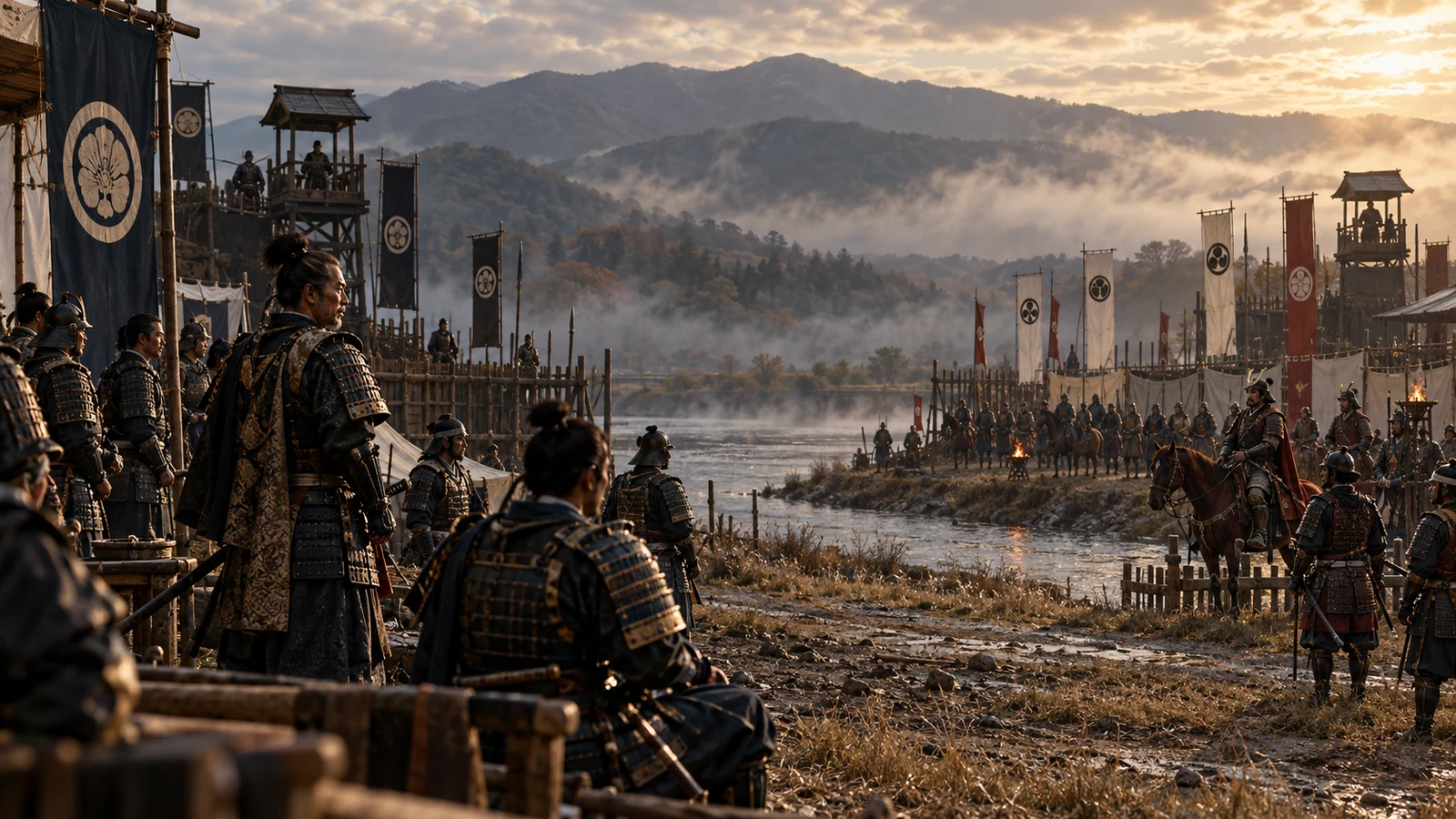
1553–1564 · Struggles over Kawanakajima
Why was Kawanakajima fought over repeatedly?
Look beyond the famous duel to local lords, rivers and castles in Shinano.
Takeda expansion and appeals from local powers
In 1553 Takeda expansion into Shinano brought confrontation with Nagao Kagetora supporting opponents such as Murakami Yoshikiyo. Castle and land losses informed their appeals. A personal rivalry alone misses local actors and territorial changes.
Rivers, castles and routes affected movement and territorial control. Taking a castle could alter access and authority beyond one battlefield. Incoming armies and local powers joined the conflict with differing interests.
Confrontation and negotiation alongside battle
Kawanakajima covers confrontations from 1553 to 1564. In the second confrontation in 1555, Imagawa Yoshimoto mediated after a lengthy standoff. Terms included withdrawal, demolition of a castle and the return of holdings. Military pressure could change control of land through negotiation, even without a decisive battle.
The severe fighting of 1561 was one phase rather than the whole conflict. Castles, alliances and control changed between confrontations, while continued military activity required resources across years.
The duel legend and regional change
The duel statue expresses later memory, not a preserved transcript of the encounter. Legendary scenes differ from a chronology of castles and movements. Both can be studied while retaining their distinct evidential character.
Following the fifth confrontation in 1564 highlights repeated attempts to protect territory and obtain cooperation. Geography, relationships and negotiated withdrawals place warfare within political struggles over land and people.
Before and after
- 1553
The first Kawanakajima conflict.
- 1561
The fourth battle and severe fighting around Hachimanbara.
- 1564
The fifth confrontation.
Key terms
- Shinano
- The historical province corresponding broadly to Nagano.
- Peace agreement
- An agreement setting terms for ending conflict.
- Tradition
- A transmitted story whose popularity does not establish factual accuracy.
What supports the account?
Kawanakajima was not one battle alone.
Nagano’s chronology documents repeated battles and confrontations.
Do not make every confrontation identical in scale or course.
The duel is transmitted as a tradition.
The park guide identifies the battle’s many traditions.
A modern statue is not a direct record of the day.
Check your understanding
Choose an answer to reveal the explanation. Return to the article and sources when you are unsure.
Sources
- Kawanakajima historic battlefield park長野市
The 1561 battlefield setting and duel tradition.
- Chronology of the Kawanakajima conflicts長野市
Repeated conflicts from 1553 to 1564 and the forces in Shinano.
Keep exploring
1600 · Fifteenth day of the ninth lunar month
Reading Sekigahara through its records
Separate the battle’s date from the later stories told about it.
Sekigahara, Gifu1488–1580 · The Kaga Ikkō movement
Faith and power in Kaga
From a governor’s defeat to the fall of Kanazawa Midō, trace faith and political power.
Kanazawa, Ishikawa
Eighteenth century–mid-Meiji · Sea of Japan routes
Trading at each port aboard a kitamae ship
Rice, kelp, herring and used clothes: voyages profited from trading, not only freight.
Hashitate, Ishikawa / Ishikari, Hokkaidō / Osaka