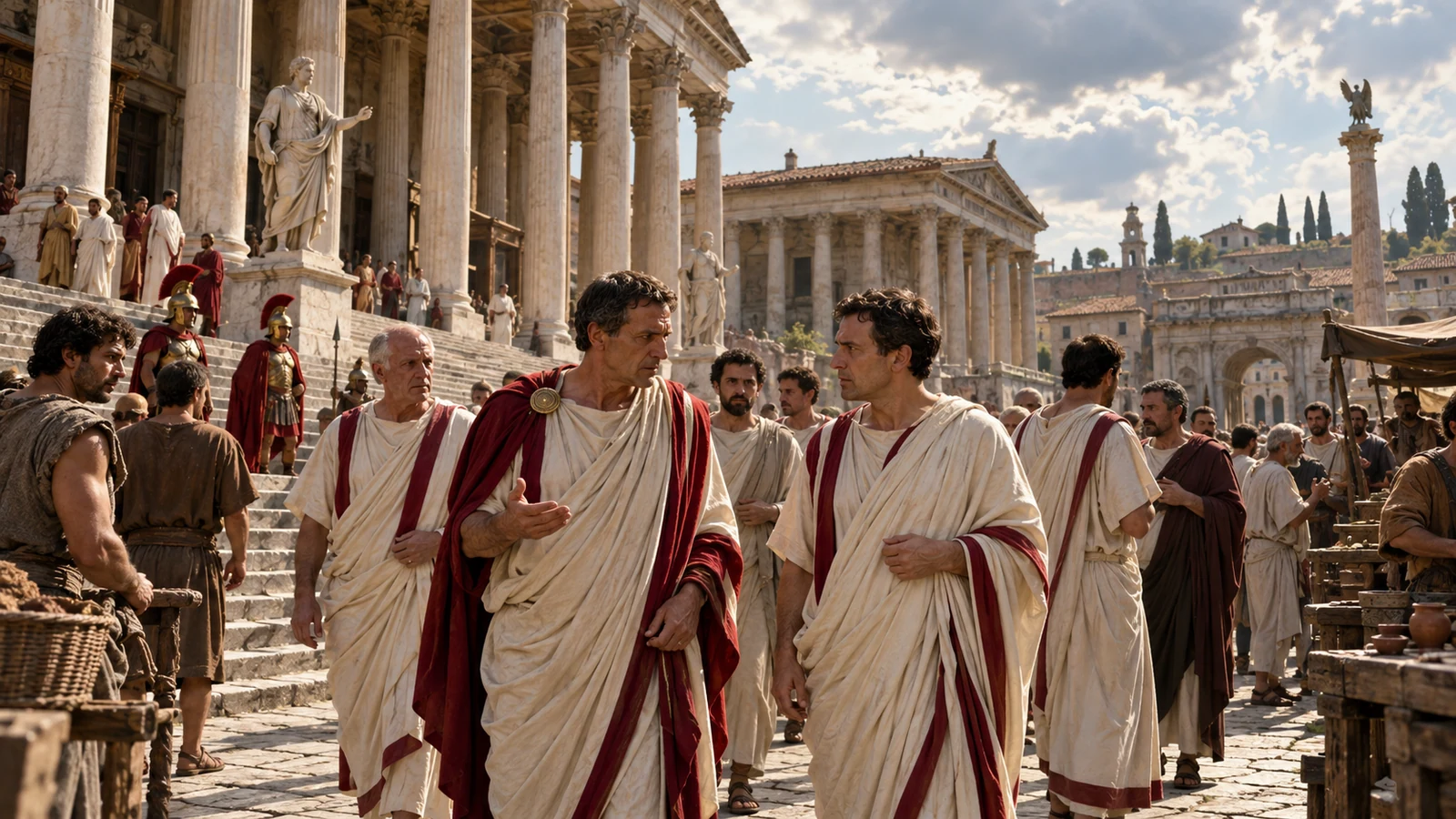
49–27 BCE
Did Caesar’s assassination restore the republic?
Follow the crisis through the Senate, armies and coinage.
Institutions can retain names while power changes
Does a senate mean every resident can participate in government?
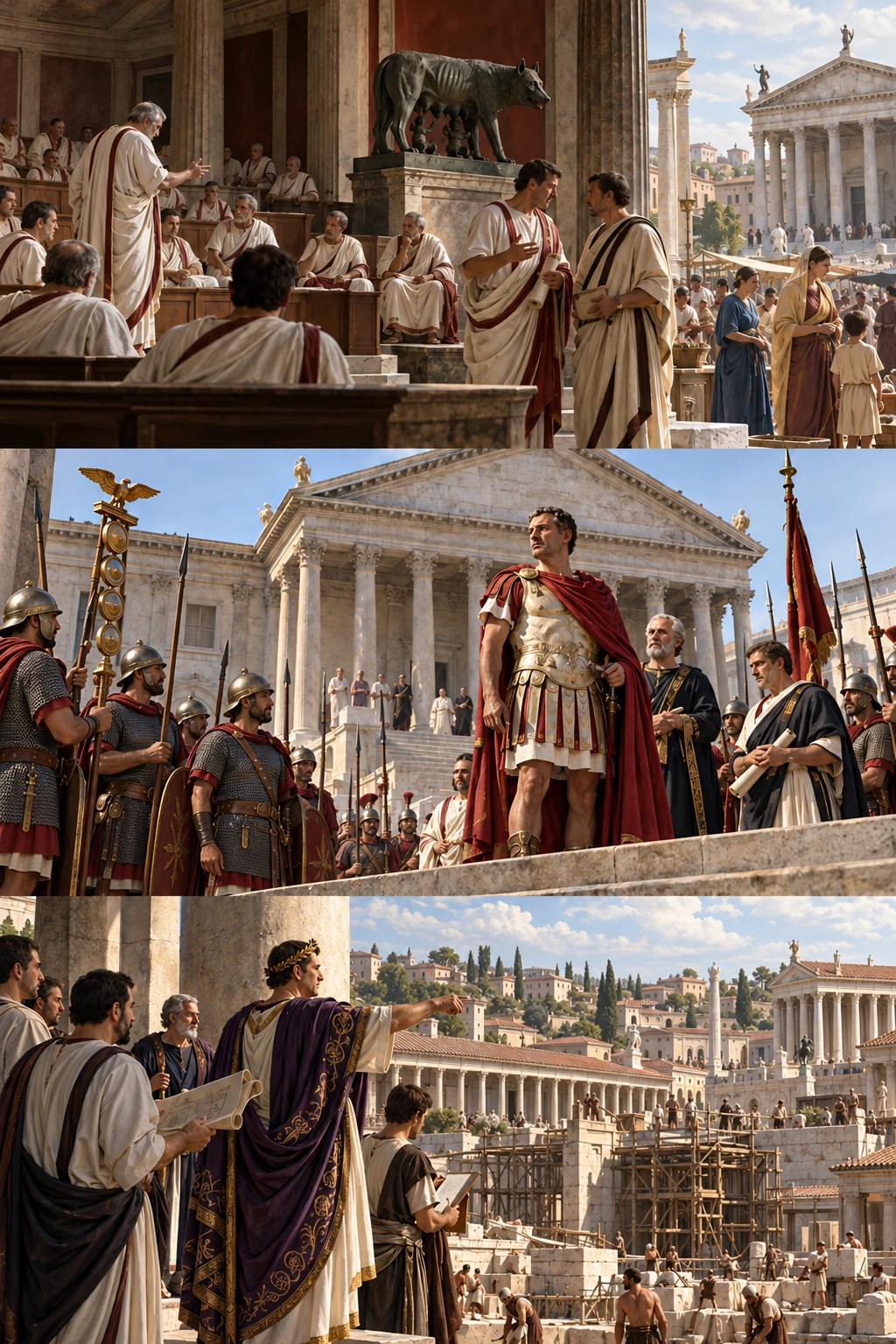
Several institutions coexist with restricted participation.
Power is organised through several institutions
Republican government had a senate and public offices, but excluded groups such as women from formal participation. Institutions do not imply universal rights.
Sources and scope
These illustrations explain processes and institutions rather than reconstructing actual people, buildings or layouts. Cutaways and insets show hidden structures or separate locations.
The Roman Republic ↗Introduction to ancient Rome ↗Territorial growth and inequality
A republic of offices and Senate came to govern wide Mediterranean territories. Provinces and wealth intensified competition among powerful commanders. Caesar’s concentration of authority emerged from this expanded setting.
Plebeians demanded their own assembly and offices over debt and public land. By 287 BCE, elite plebeians shared political standing with patricians—more than two centuries before Caesar. This combined ruling class governed through subsequent expansion.
Caesar’s military and public authority
Dictator was a Roman office, but Caesar’s perpetual title challenged republican limits. His assassins issued coinage with a liberty cap, two daggers and the date 15 March. It justified their act rather than proving stable institutional recovery.
Civil wars after the assassination and new government
Civil war continued; Octavian’s side won at Actium in 31 BCE. In 27 BCE he received the title Augustus and authority over important provinces. Personal power operated with surviving offices and the Senate, supported by urban supply and public works.
Before and after
- 509 BCE
Traditional beginning of the Republic.
- 287 BCE
Elite plebeians achieved political equality after the Conflict of the Orders.
- 15 March 44 BCE
Caesar assassinated.
- 31 BCE
Battle of Actium.
- 27 BCE
Octavian received the title Augustus.
Key terms
- Senate
- An influential Roman political council.
- Dictator in perpetuity
- The indefinite dictatorship acquired by Caesar.
- Justification
- An argument or image presenting an act as legitimate.
What supports the account?
Multiple offices indicate institutional sharing, not participation by every inhabitant. The system also existed within a slaveholding society.
Republican society, expansion and struggles for authority. Perpetual dictatorship, the assassination coin, civil war and Augustus.
Political eligibility and residence are distinct.
Armies and supporters became political power. Ask who could issue effective orders rather than reading office names alone.
Republican society, expansion and struggles for authority. Perpetual dictatorship, the assassination coin, civil war and Augustus.
Institutional names alone do not explain effective authority.
Check your understanding
Choose an answer to reveal the explanation. Return to the article and sources when you are unsure.
Sources
- The Roman RepublicThe Metropolitan Museum of Art
Republican society, expansion and struggles for authority.
- Introduction to ancient RomeBritish Museum
Perpetual dictatorship, the assassination coin, civil war and Augustus.
- Augustan government and the cityThe Metropolitan Museum of Art
Temple and ritual revival, artistic patronage, water and food supply and public amenities.
- Public office and Augustan authorityThe Open University
Caesar’s consulships and dictatorship, and Augustus’s provincial authority in 27 BCE; relevant passage verified through search indexing.
Keep exploring
79 CE
Everyday life preserved at Pompeii
A buried city preserves traces of meals, commerce and household work.
PompeiiFifth–fourth centuries BCE
Democracy and the Agora in Athens
A city where politics and commerce met: who could participate, and who could not?
Athens
Comparing 1377 and the 1450s
Gutenberg and the work of movable type
Type, printing and hand decoration reveal workshop processes.
Mainz / Cheongju