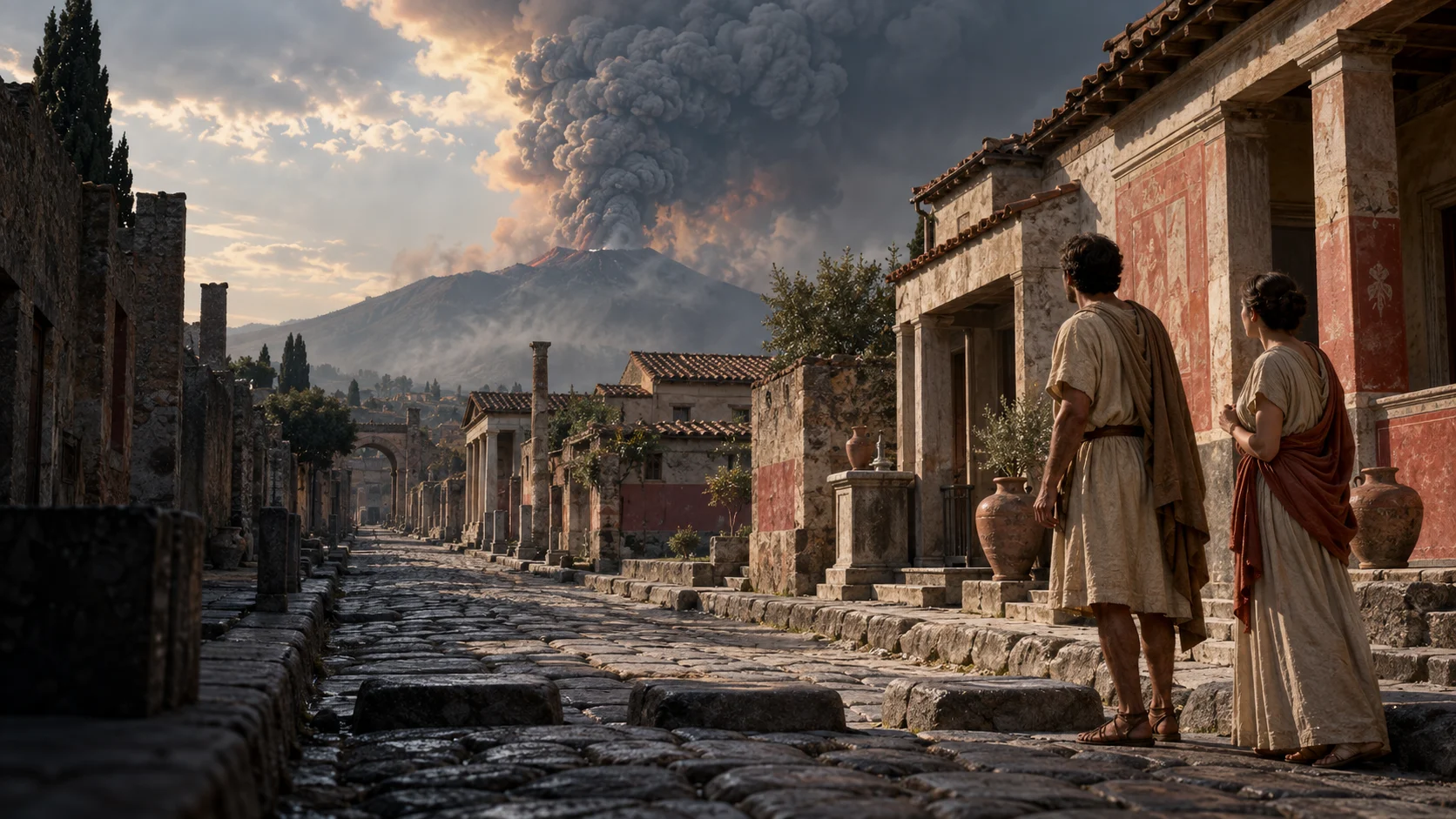
79 CE
Everyday life preserved at Pompeii
A buried city preserves traces of meals, commerce and household work.
Life before the eruption
Before the eruption, Pompeii’s inhabitants bought bread, repaired homes and supplied shops. Mills and ovens reveal how raw grain became a product. They preserve working lives less visible in lavish wall paintings.
Popidius Priscus’s bakery used lava mills turned by enslaved workers or animals, followed by an oven. With no surviving counter, suggested selling methods remain less certain than the equipment.
Work connecting shops and homes
Streets linked homes, shops and baths; residents relied on facilities beyond the household. Buildings changed use and construction continued. The eruption buried a city being repaired and reused, not a uniformly finished monument.
The House of the Oven was an older residence converted after earthquake damage. Unfinished painting and water works elsewhere reveal a city changing before 79 CE.
What the buried city preserved
Burial preserved objects through a disaster destroying lives. Modern excavation from 1748 exposed paintings to light and rain, with fading in some cases. Burial covered the city; excavation revealed it; conservation now limits the resulting damage.
Before and after
- Second century BCE
The residence later known as the House of the Oven was built.
- 79 CE
The eruption buried the town, preserving changes of use and unfinished decoration.
- 1748
Modern excavation began.
Key terms
- Find context
- The location and layer of discovery.
- Deposits
- Layers of accumulated volcanic material.
- Conservation
- Work limiting deterioration and preserving evidence.
What supports the account?
Mills and ovens reveal a breadmaking sequence. Buildings provide evidence of working processes.
Homes, shops, baths, bakery mills and ovens, and the eruption of 79 CE. Revisiting and reuse after the eruption and excavation from 1748.
An oven cannot identify everyone who worked there.
People revisited the town and recovered materials afterward. Find locations need not always equal ancient use locations.
Homes, shops, baths, bakery mills and ovens, and the eruption of 79 CE. Revisiting and reuse after the eruption and excavation from 1748.
Individual movements of objects require investigation.
Check your understanding
Choose an answer to reveal the explanation. Return to the article and sources when you are unsure.
Sources
- A Guide to the Pompeii ExcavationsParco Archeologico di Pompei
Homes, shops, baths, bakery mills and ovens, and the eruption of 79 CE.
- Pompeii after the eruptionParco Archeologico di Pompei
Revisiting and reuse after the eruption and excavation from 1748.
Keep exploring
49–27 BCE
Did Caesar’s assassination restore the republic?
Follow the crisis through the Senate, armies and coinage.
RomeFifth–fourth centuries BCE
Democracy and the Agora in Athens
A city where politics and commerce met: who could participate, and who could not?
Athens
Comparing 1377 and the 1450s
Gutenberg and the work of movable type
Type, printing and hand decoration reveal workshop processes.
Mainz / Cheongju