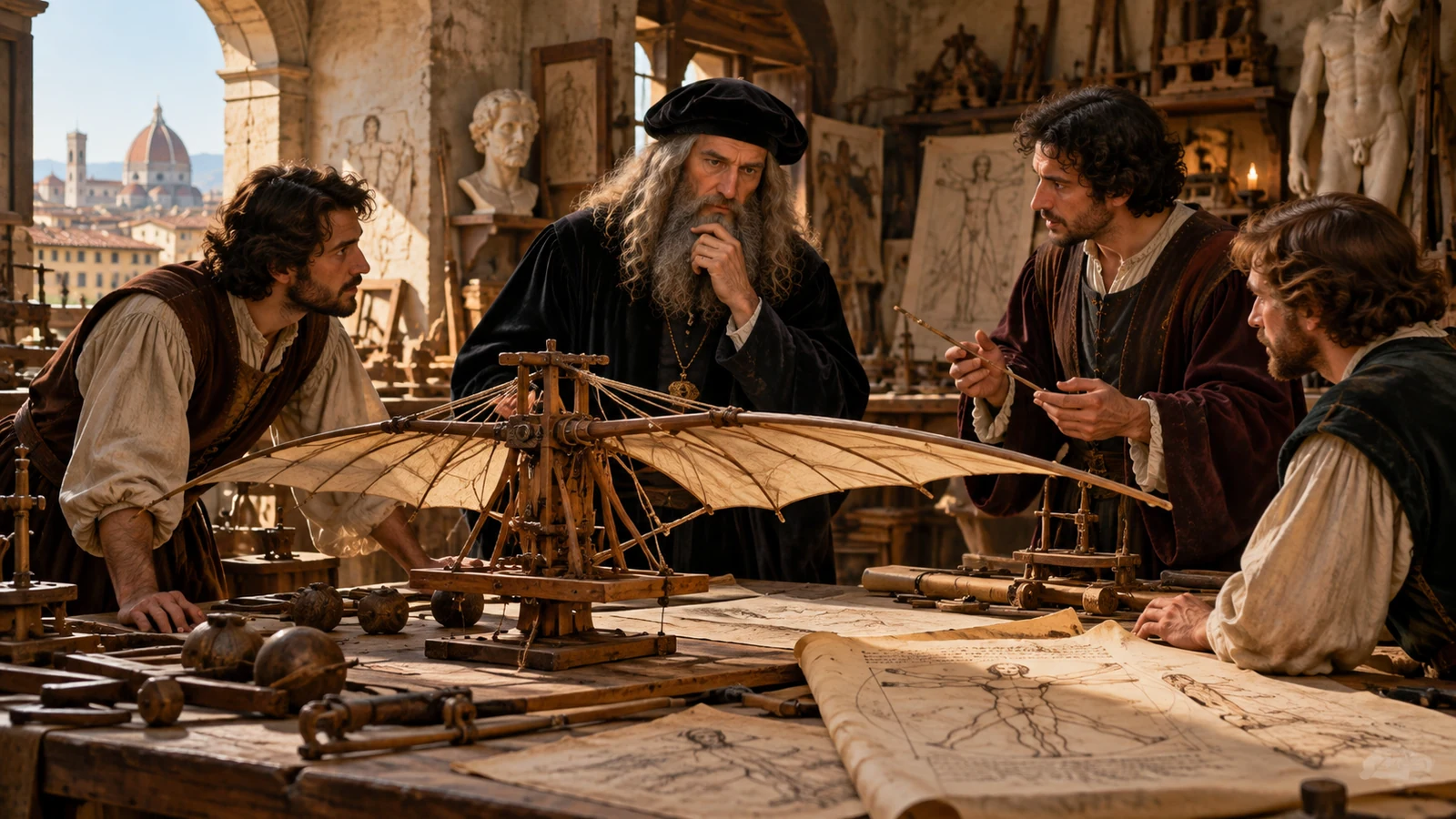
Notebooks from around 1487–1505
Reading Leonardo’s notebooks
Water, weights and anatomy reveal observation and design.
An engineer thinking on paper
A drawn machine is not necessarily a machine that ran. Leonardo’s papers mix hydraulic devices, calculations, clothing and notes. They record thinking between court commissions and personal observation rather than a catalog of completed inventions.
Forster I combines Milanese water devices from around 1487–1490 with Florentine shape-and-volume work of July 1505. Volume numbering is not chronological order.
Investigating water and weights
Diagrams allowed forces and weights to be followed on paper. The notebooks include examination and rejection of perpetual-motion ideas. Drawing helped test and revise proposals, not merely display them.
Notes on proportion and Pacioli around 1495 coexist with later weights and mechanics. Mirror writing may relate to left-handed use, not necessarily secrecy. Direction and content are distinct issues.
Design, proposal and realization
Writing crossing an inner margin can reveal work done before folding. Later binding joined papers from different times, so current order is not writing order. A modern model based on a drawing likewise does not prove Leonardo built and ran it.
Before and after
- Around 1487–1490
Early sheets now in Forster I.
- Around 1495–1497
Studies of weights and other topics in Forster II.
- July 1505
The Florence notebook on transformation.
- 1876
Forster’s bequest brought the notebooks into the V&A collection.
Key terms
- Mirror writing
- Writing read with left and right reversed.
- Leaf
- An individual sheet in a bound volume.
- Proposal
- A design or plan proposed before realization.
What supports the account?
Water devices and anatomy appear within the same corpus. Ask what was measured or tested rather than using variety alone to build a genius myth.
Forster Codices, dates, hydraulics, weights, mirror writing, Pacioli and binding. Collection context and Forster II, 1495–1497.
A drawing alone does not prove realization.
References to Pacioli connect mathematical work with others. Colleagues and commissions place observation within social activity.
Forster Codices, dates, hydraulics, weights, mirror writing, Pacioli and binding. Collection context and Forster II, 1495–1497.
The reason for mirror writing cannot be fixed to one motive.
Check your understanding
Choose an answer to reveal the explanation. Return to the article and sources when you are unsure.
Sources
- Leonardo da Vinci’s notebooksVictoria and Albert Museum
Forster Codices, dates, hydraulics, weights, mirror writing, Pacioli and binding.
- Manuscripts collectionVictoria and Albert Museum
Collection context and Forster II, 1495–1497.
Keep exploring
1428–1453
Joan of Arc and the siege of Orléans
Read siege, coronation and trial within the Hundred Years War.
Orléans
Comparing 1377 and the 1450s
Gutenberg and the work of movable type
Type, printing and hand decoration reveal workshop processes.
Mainz / CheongjuLate eighteenth–early nineteenth centuries
Steam engines and working lives
Powering factories also changed working hours and children’s lives.
Industrial Britain