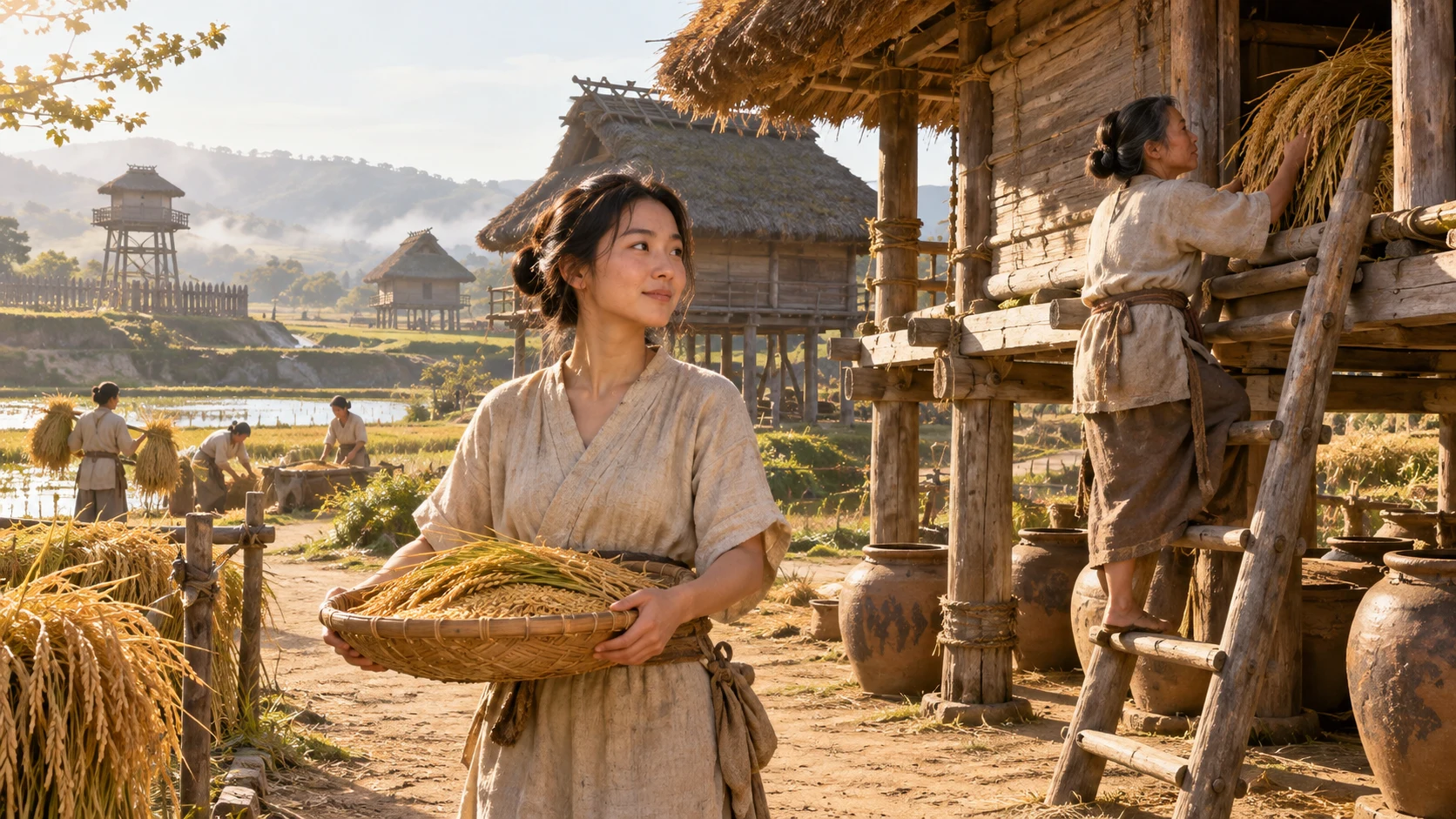
c. fifth century BCE–third century CE · Yayoi period
Yoshinogari and emerging political centres
Changing ditches, storehouses and graves show a settlement becoming a regional centre.
Homes, stores and protected spaces
Does a growing settlement only need more buildings?
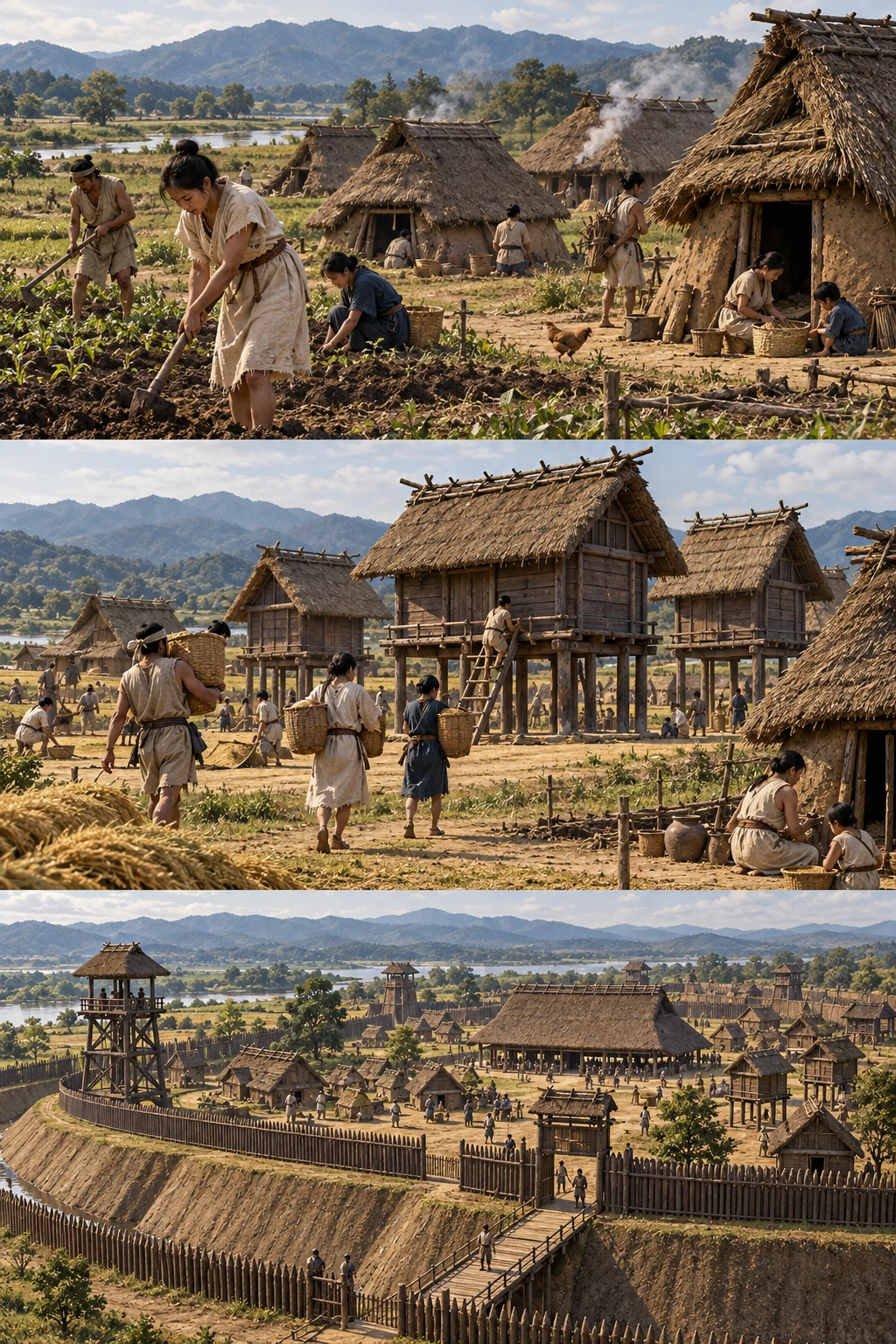
Places to live develop on the hills.
Communities establish places to live
Yoshinogari changed over the Yayoi period. It did not begin as the large centre represented by today’s reconstruction.
Sources and scope
These illustrations explain processes and institutions rather than reconstructing actual people, buildings or layouts. Cutaways and insets show hidden structures or separate locations.
History of Yoshinogari ↗Villages develop into a regional centre
Yoshinogari began with small Yayoi settlements, followed by a southern enclosed settlement and later expansion northwards. Concentrating harvests created needs for storage and protection. Changes in the arrangement of homes, stores and ditches record a developing regional centre rather than a complete capital built at once.
Enlarging ditches took substantial labour. Defence probably protected accumulated supplies as well as inhabitants. Inner enclosures further differentiated access to particular spaces. Settlement growth was accompanied by developing means of organising defence and the use of land.
Stores, crafts and outside connections
A large farming settlement also needed wooden implements, vessels, textiles and metalworking. Separate residential and storage areas distinguish everyday living from the concentration of supplies. Later raised-floor stores suggest regional gathering of produce, without identifying every institution as a modern market or tax office.
Metalworking required material supply and controlled heating. Casting equipment makes the settlement a manufacturing place as well as a destination for goods. Korean-style pottery and a wooden boat representation point towards wider connections. Agriculture, crafts and movement formed related parts of its activity.
Burials and political distinction
Middle-phase jar burials formed long rows, and the northern mound contained bronze swords and glass beads. Differences in burial scale and goods support interpretation of social distinctions. Later graves are fewer, with no comparable special mound established. Combining the largest later buildings with earlier rich burials obscures that chronological change.
Large buildings, inner enclosures and stores made later Yoshinogari a useful case for examining a regional political centre. That does not establish its identity as Yamatai from written accounts. Archaeology documents changing regional functions more securely than a complete list of rulers or the settlement’s ancient name.
Before and after
- Fifth–second centuries BCE
Early villages and an early enclosing ditch.
- Second century BCE–first century CE
Middle-phase enclosure, mound and jar burials.
- First–third centuries CE
Later inner enclosures and a major settlement develop.
Key terms
- Enclosing ditch
- A surrounding ditch, distinguished here from a water-filled moat.
- Burial mound
- A grave within a built-up earthen mound.
- Regional leader
- An influential person exercising leadership within a community.
What supports the account?
Social distinctions existed.
Burials differ in scale and grave goods.
Burials alone cannot reveal everyone’s work or legal status.
The reconstruction focuses on the third century.
The park distinguishes settlement phases.
Do not apply that layout to the whole Yayoi period.
Check your understanding
Choose an answer to reveal the explanation. Return to the article and sources when you are unsure.
Sources
- History of Yoshinogari吉野ヶ里歴史公園
Development by phase, enclosures, storage, graves, reconstruction date and dry ditches.
- About the Yoshinogari site吉野ヶ里歴史公園
Extent of the site and changing Yayoi settlement.
Keep exploring
1274 and 1281 · Two Mongol invasions
Building a stone barrier at Hakata Bay
A barrier built between two invasions reveals defence and maritime exchange.
Hakata Bay, Fukuoka
1401–mid-sixteenth century · Trade with Ming China
The tally checked at the port
A tally identified authorised missions: follow the links between diplomacy and commerce.
Hakata, Fukuoka / Kyoto
1641–1859 · The Dutch trading post at Dejima
Overseas connections through Dejima
Trade and information exchange on an artificial island, interpreted through its reconstruction.
Dejima, Nagasaki