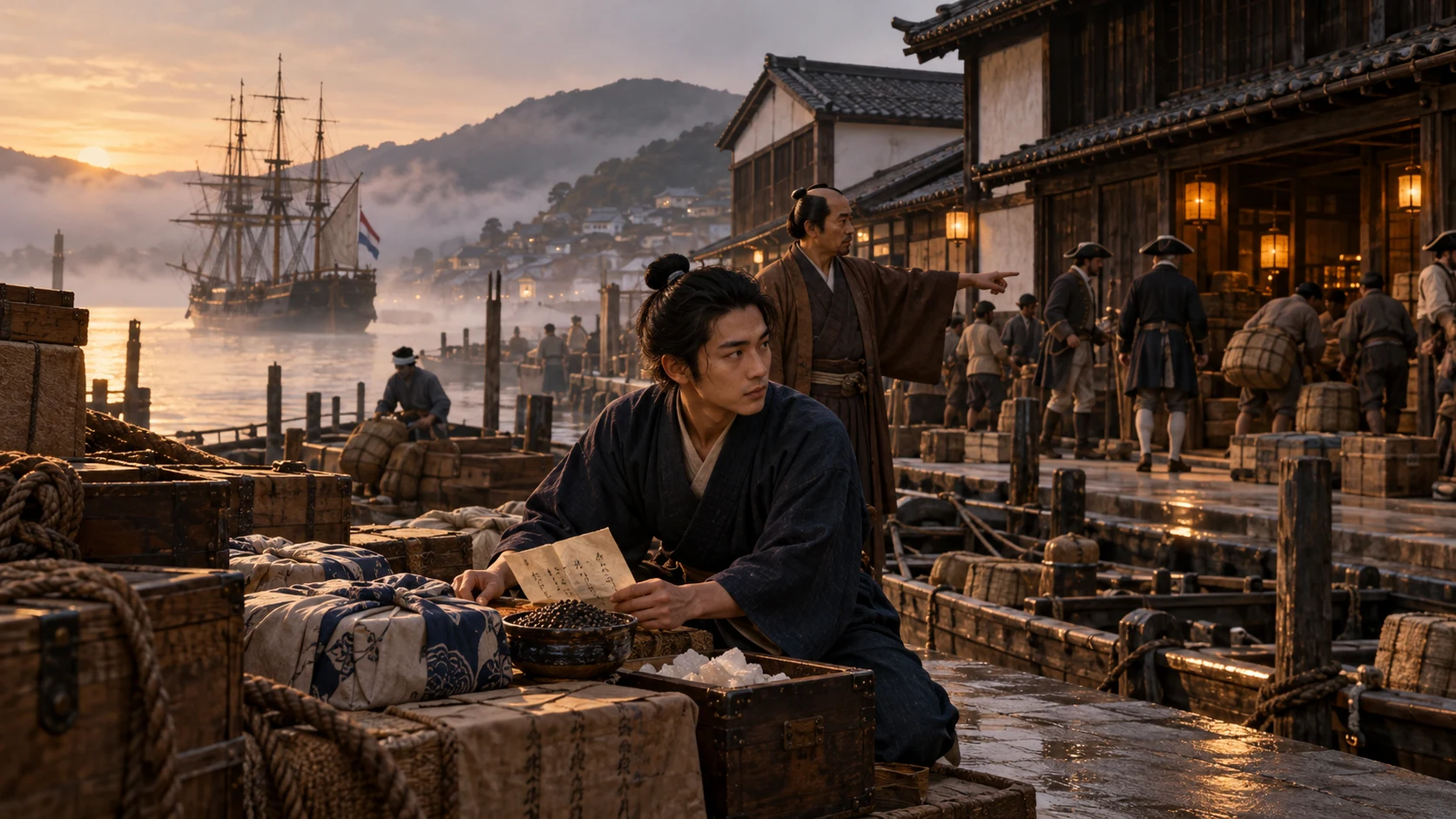
1641–1859 · The Dutch trading post at Dejima
Overseas connections through Dejima
Trade and information exchange on an artificial island, interpreted through its reconstruction.
How overseas news reached Edo
How can news travel between people using different languages?
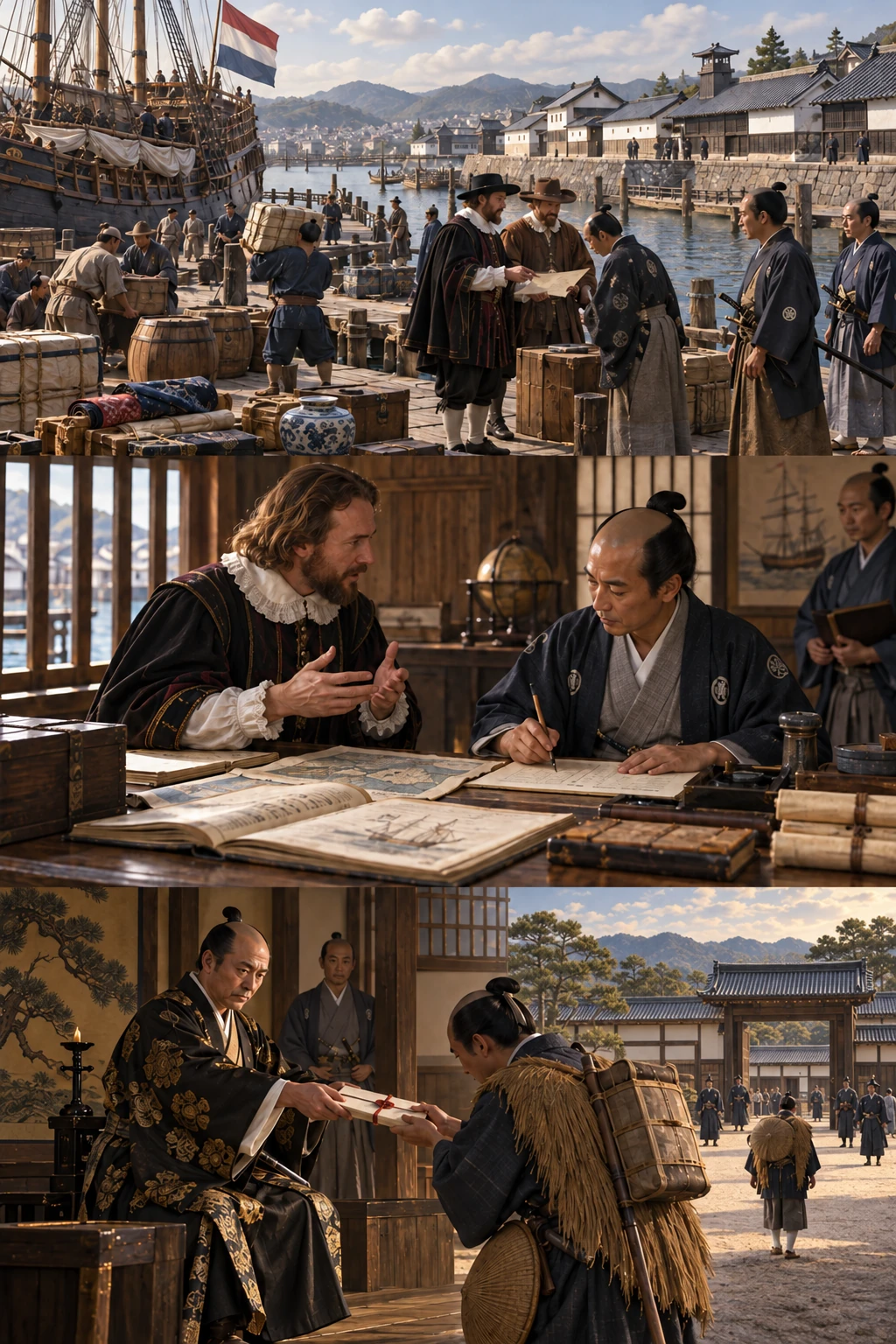
Information reaches the port and trading post.
Ships carry goods and information
The Dutch post moved from Hirado to Dejima in 1641. The trading post also provided the shogunate with news about overseas affairs.
Sources and scope
These illustrations explain processes and institutions rather than reconstructing actual people, buildings or layouts. Cutaways and insets show hidden structures or separate locations.
History of Dejima ↗From Portuguese accommodation to a Dutch factory
The shogunate obtained goods from foreign trade while restricting Christianity and movement. Dejima’s artificial island gave these policies a physical form, permitting exchange while limiting contact with the surrounding city.
Twenty-five Nagasaki merchants financed the island completed in 1636. It became unoccupied after the Portuguese expulsion in 1639, before the Dutch post moved from Hirado in 1641. It was not originally built for Dutch residents. A merchant-financed facility served changing shogunal controls over its occupants and use.
How cargo and news passed through
Arrival was followed by checks of origin and crew, cargo inspection, unloading and bidding. Sailors, workers, merchants, interpreters and officials performed different stages. Trade cannot be reduced to one foreign merchant handing a product to a local customer.
Interpreters helped turn overseas reports into documents forwarded to Edo. Commercial routes overlapped channels of political information. Translation and recording made spoken accounts usable in official decision-making.
Changing goods and changing functions
Trade shifted from prominent early silk and silver exchanges towards other goods, including copper, sugar and books. Dutch vessels did not carry only products made in the Netherlands; Asian routes supplied a wider network reaching Nagasaki.
After the factory closed in 1859, systems of foreign contact changed. Reclamation altered the island’s surroundings, now interpreted through investigation and reconstruction. Its restricted space sustained connections reaching far beyond its boundaries.
Before and after
- 1636
The artificial island is completed.
- 1639
Portuguese residents are expelled.
- 1641
The Dutch factory relocates from Hirado.
- 1859
The Dutch factory closes.
Key terms
- Trading factory
- A base for merchants, storage and trade.
- Interpreter
- A person translating and mediating negotiations and news.
- News report
- A report conveying overseas information to the shogunate.
What supports the account?
Completion and Dutch occupation have different dates.
The historical guide distinguishes 1636 and 1641.
The island was not originally only for Dutch residents.
Today’s appearance includes researched reconstruction.
The restoration project describes comparing models and records.
Do not treat the whole scene as an unchanged Edo survival.
Check your understanding
Choose an answer to reveal the explanation. Return to the article and sources when you are unsure.
Sources
- History of Dejima長崎市・出島
Construction, Dutch relocation, overseas reports and closure in 1859.
- Dejima restoration programme長崎市・出島
Landscape change, reconstruction and comparison of models with other evidence.
Keep exploring
1867 · Reorganisation as Kaientai
What did Ryōma’s Kaientai do?
Rules and letters reveal an organisation concerned with navigation, English and commerce.
Kōchi / Nagasaki
1401–mid-sixteenth century · Trade with Ming China
The tally checked at the port
A tally identified authorised missions: follow the links between diplomacy and commerce.
Hakata, Fukuoka / Kyoto1945 · The Battle of Okinawa and its aftermath
Life after the Battle of Okinawa
Follow the ground battle, civilian displacement, camps and the return home.
Okinawa