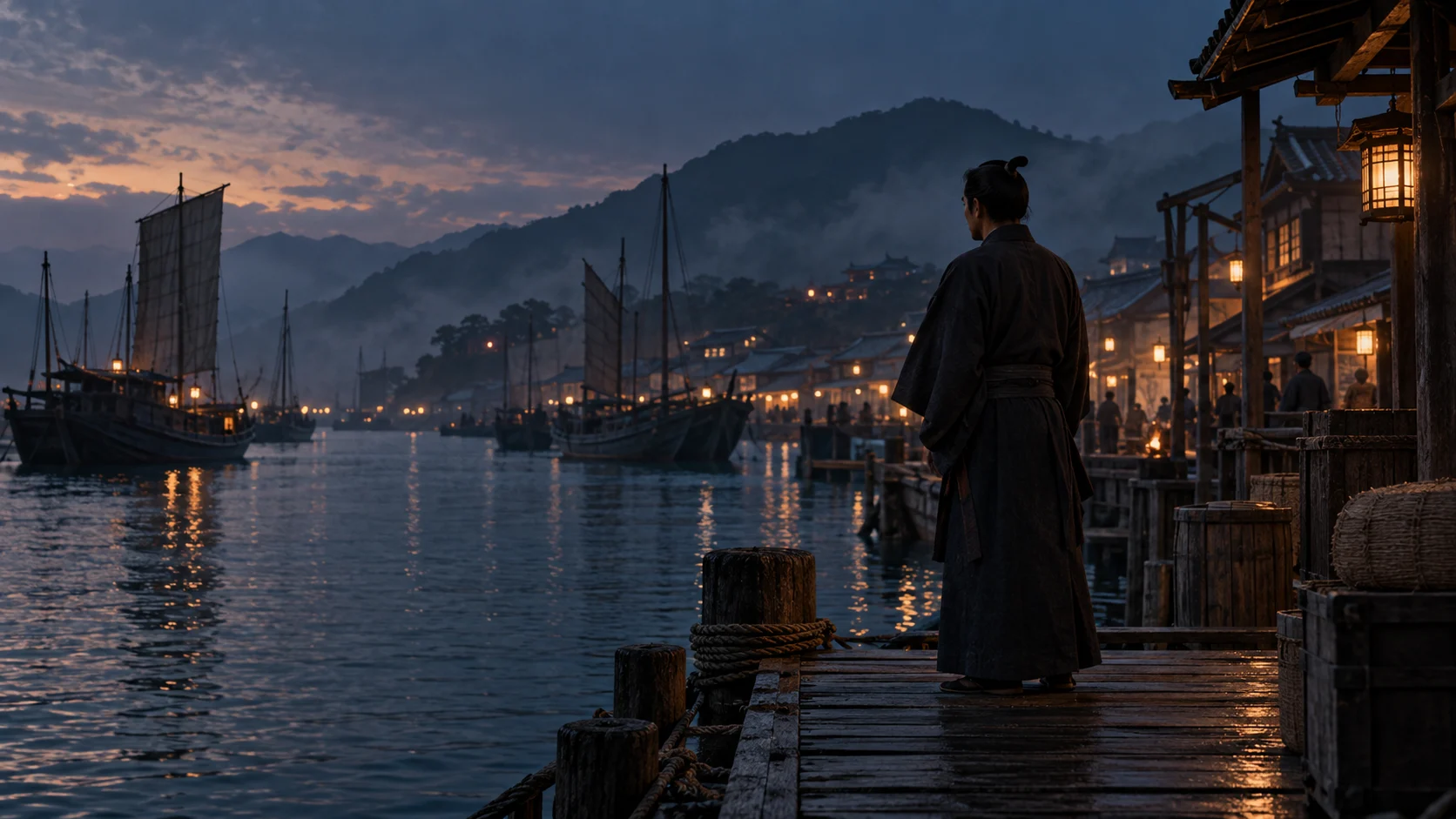
1867 · Reorganisation as Kaientai
What did Ryōma’s Kaientai do?
Rules and letters reveal an organisation concerned with navigation, English and commerce.
Organising a group in Nagasaki
Ryōma and associates organised Kameyama Shachū in 1865. Nagasaki connected goods, vessels and information. Political aims needed practical navigation, transport and finance, performed by a group rather than an individual alone.
Reorganisation as Tosa’s Kaientai in 1867 changed its relationship with domain authority. A modern company label alone misses the overlap of domain, military and political activity. Its aims and institutional support must be considered together.
Learning while navigating and trading
Kaientai’s rules describe navigation, learning and commerce. Steering, understanding foreign language and judging transactions were distinct but connected skills. Combining training with activity suited a group operating in an international port.
Rules state intended activity rather than proving that every task succeeded. Separate records are needed for individual outcomes. That distinction places the group’s shared learning and decisions alongside Ryōma’s more familiar personal story.
Political relationships in correspondence
Letters identify messages addressed to particular people and situations. They differ from famous sayings in later biographies. Dates, recipients and purposes make political relationships and contemporary judgements more concrete.
Ryōma’s death in 1867 ended his brief activity, but later institutions cannot be reduced to one person’s plan. Different domains and actors made decisions. Maritime rules and practice show how transport, information and finance supported political change.
Before and after
- 1865
Kameyama Shachū is organised in Nagasaki.
- 1867
Reorganisation as Tosa’s Kaientai with Ryōma as leader.
- 1867, during Kaientai’s operation
Rules define navigation, learning and commercial purposes.
Key terms
- Kaientai
- A Tosa organisation engaged in navigation and commerce.
- Rules
- Rules defining an organisation’s purpose and conduct.
- Transcription
- Rendering a source’s writing as readable text.
What supports the account?
Kaientai connected learning to work.
Its rules name navigation, English and commerce.
A rule does not prove every item was always implemented.
Displays include reproductions.
The museum identifies originals and copies.
Do not identify every displayed sheet as his autograph.
Check your understanding
Choose an answer to reveal the explanation. Return to the article and sources when you are unsure.
Sources
- Collection: Kaientai rules and Ryōma’s letters高知県立坂本龍馬記念館
Reorganisation in 1867, links to Tosa, navigation, English and original or reproduced letters.
- Nagasaki Kameyama Shachū Memorial Museum長崎市・長崎国際観光コンベンション協会
Activity linking Tosa and Nagasaki, Kameyama Shachū and transport and commercial purposes in the rules.
Keep exploring
1641–1859 · The Dutch trading post at Dejima
Overseas connections through Dejima
Trade and information exchange on an artificial island, interpreted through its reconstruction.
Dejima, NagasakiNineteenth century · Uchiko from late Edo into Meiji
Uchiko’s streets and wax production
Look behind merchant-house façades to the workplaces of wax production.
Uchiko, Ehime1945 · The Battle of Okinawa and its aftermath
Life after the Battle of Okinawa
Follow the ground battle, civilian displacement, camps and the return home.
Okinawa