c. fifth century · Kofun period
The society that built giant burial mounds
Daisen Kofun in Sakai links monumental tombs with emerging royal power.
A tomb reshapes the landscape
Building Daisen Kofun required more than heaping soil: workers shaped moats and slopes and made and fired clay haniwa. Around the fifth century these different tasks were concentrated on a monumental tomb in Mozu. The mound covered a burial space while occupying a conspicuous landscape position that is interpreted as an expression of power.
Terraced construction gave the mound a recognisable profile above ground. Its height and shape remained visible after burial, while the burial chamber itself was concealed. The visible monument can therefore be understood as a continuing expression of authority as well as a place for the dead.
Moving earth and making haniwa
Construction joined excavation, transport, shaping and ceramic work. Haniwa required clay gathering, forming and firing. Coordinating earthworks with craft production demonstrates organisation, even though modern machine-based building schedules cannot establish the actual duration of ancient work.
Keyhole tombs stood alongside round and square mounds. Differences in form and scale inform relationships among influential people. Examining neighbouring tombs and their dates places the largest monument within a developing regional society instead of treating it as an isolated achievement.
The Sakai museum identifies stone transported from Hyōgo for a large coffin. Local earthmoving and long-distance stone transport required different arrangements, revealing connections beyond the immediate mound.
The 1872 discovery records armour, swords and glass vessels, with some reconstructions dependent on contemporary drawings after reburial. Different materials imply distinct production, while surviving objects and recorded objects provide different evidence.
Named imperial tombs and archaeological knowledge
Daisen is managed by the Imperial Household Agency as Emperor Nintoku’s tomb. That designation and archaeological dating answer different questions. Recognising the distinction permits study of construction and society without pretending that every burial identity or precise year has been independently established.
Moats and surrounding land changed after construction. Aerial views clarify the overall shape without reproducing the fifth-century setting. Combining the monument, neighbouring tombs and recovered objects makes it evidence for social activity as well as a named landmark.
Before and after
- Late fourth–early fifth century
Approximate start of construction in the Mozu group.
- c. fifth century
Approximate construction period of Daisen Kofun.
- 1872
A chamber, coffin and grave goods are discovered and drawn.
Key terms
- Keyhole-shaped tomb
- A mound combining rectangular and circular sections.
- Haniwa
- Unglazed clay objects placed on and around burial mounds.
- Person buried
- The person interred; an official name alone does not prove identity.
What supports the account?
Construction dates approximately to the fifth century.
Based on the Sakai museum’s dating.
This does not establish an exact completion year.
Form and scale inform political status.
The tomb group contains varied sizes and forms.
Every difference cannot be reduced to one simple rank order.
Check your understanding
Choose an answer to reveal the explanation. Return to the article and sources when you are unsure.
Sources
- Encyclopedia of Nintoku’s mausoleum堺市博物館
Dating, dimensions, tomb forms, political status and surrounding mounds.
- Burial mounds of Sakai堺市
The Mozu group and Daisen Kofun’s dimensions.
- Mozu tomb database堺市
The tomb group’s construction beginning in the late fourth to early fifth century.
Keep exploring
588–694 · Palaces and temples in Asuka
Temples rise in Asuka
Palaces, tiles and a water clock reveal a changing political and cultural centre.
Asuka, Nara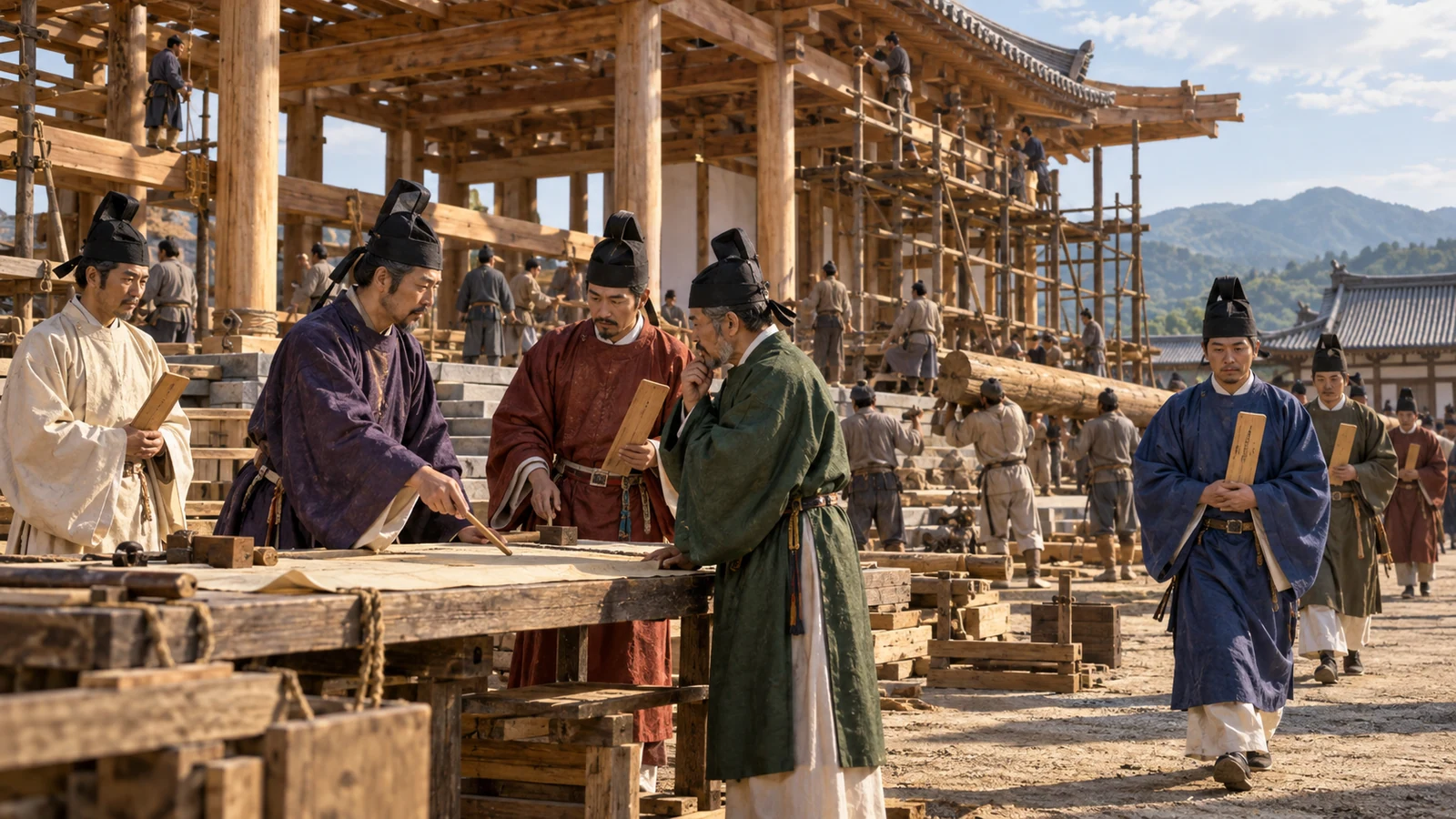
645–701 · From coup to legal codes
The Taika reforms were not a single-day change
Separate the assassination of Soga no Iruka from the later formation of state institutions.
Asuka, Nara / Naniwa, Osaka710–784 · Interrupted by temporary capital moves
The work that sustained Heijō-kyō
Avenues and offices reveal how the Nara capital functioned.
Heijō-kyō, Nara