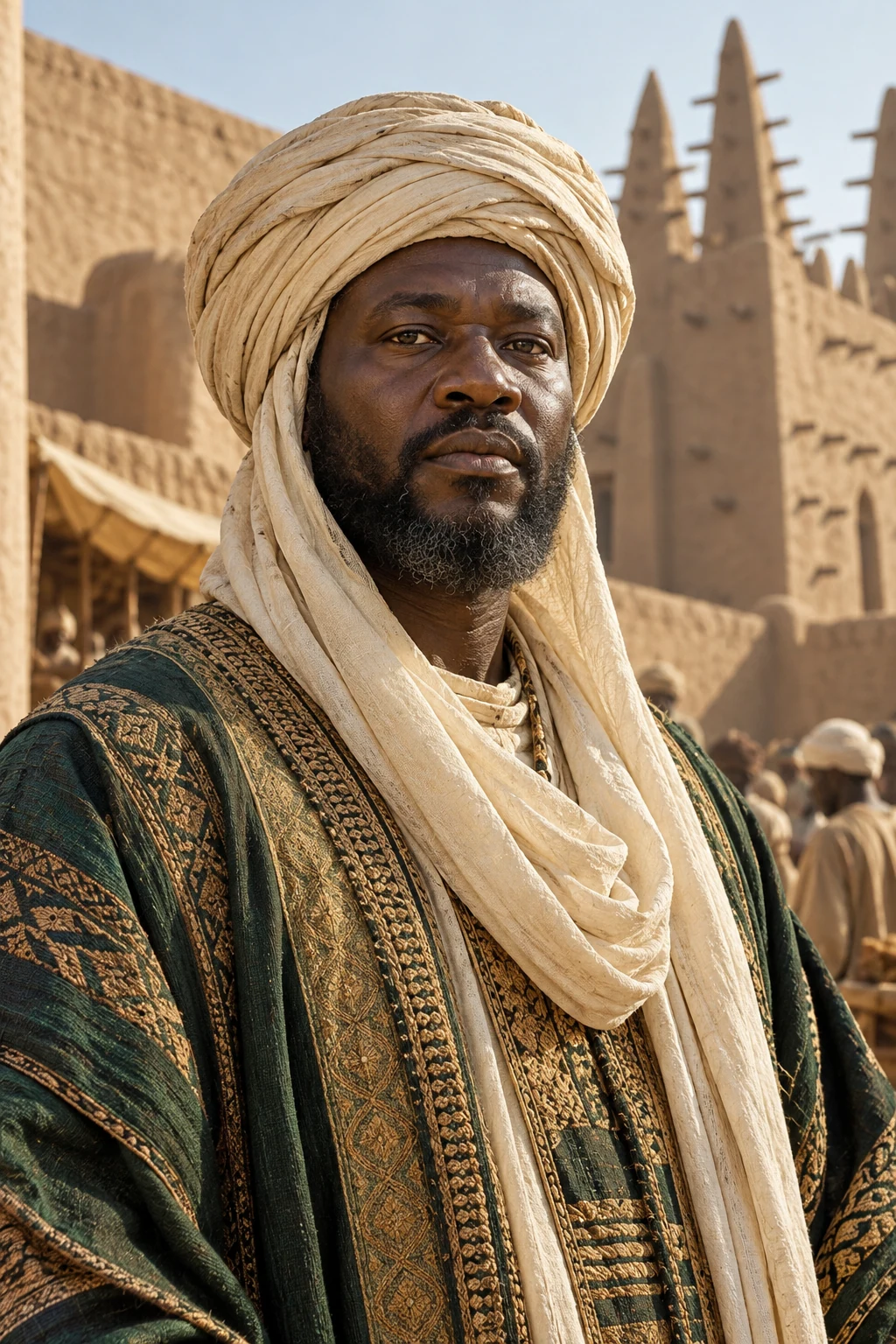
Early 14th century; exact life dates unknown
Mansa Musa
Ruler of Mali
Known widely for his pilgrimage in 1324. His history includes the societies sustaining trans-Saharan commerce and scholarship, not gold alone.
A king travels with wealth built by a society
In 1324 Musa of Mali set out for Mecca. Accounts of his gifts and spending in gold spread through Cairo, bringing an unfamiliar West African ruler to wider attention. Trade and the people supplying food and transport sustained that wealth.
Timbuktu’s position near the desert gateway and Niger connected trade from different regions. Salt, gold and grain drew merchants and information. River and desert conditions shaped commerce alongside royal authority.
Caravans depended on guides, seasonal timing, water and provisions. Valuable gold still needed transport to become exchanged wealth. The Sahara posed obstacles but also routes navigated through practical knowledge.
What the pilgrimage communicated abroad
The pilgrimage of 1324–1325 joined religious observance with a ruler’s movement abroad. Companions, supplies and foreign relationships were necessary. The route also made Mali more widely known to distant cities and rulers.
Accounts of gold gifts and expenditure spread Mali’s reputation through Cairo. A ruler’s use of resources also expressed relationships. The lasting interest in gold shows what distant observers selected to remember about the kingdom.
The Catalan Atlas of about 1375 pictures Musa holding gold after his lifetime. This European map represented information about West African wealth. Trade and pilgrimage left traces in distant records beyond his return.
Timbuktu and its mosque after the return
UNESCO links Djingareyber’s initial construction with Musa’s return. Patronage supported urban religious infrastructure, while materials and skilled building labor made it possible. Resources became an enduring institution through work in the town.
Earthen buildings required repair and transmitted maintenance techniques. Timbuktu’s mosques preserve that continuing practice. Musa’s patronage was an initial landmark; later craftspeople and residents sustained use and changed their form.
Worship drew teachers and learners, alongside copying and keeping books. Royal patronage left a remembered name, but continuing learning required people who used the places day after day.
The town sustained after Musa
Timbuktu’s scholarly and cultural flowering in the fifteenth and sixteenth centuries followed Musa’s life. Mosques and learning institutions sustained Islamic scholarship through conditions maintained across generations.
The sixteenth-century qadi Al Aqib rebuilt and enlarged Djingareyber and Sankore. Later leaders adapted inherited institutions rather than only preserving them unchanged. Surviving space contains work from several periods.
The pilgrimage and Timbuktu’s buildings used wealth differently. Gifts abroad generated reputation; local places of worship were used and altered over time. Both outlasted the king in different forms.
Turning points
- Early fourteenth century
Ruled Mali.
- 1324–1325
Made the pilgrimage to Mecca.
- After his return
Supported a mosque in Timbuktu.
- 1375, after his lifetime
His wealth was represented in the Catalan Atlas.
- Fifteenth–sixteenth centuries, later urban history
Timbuktu’s scholarly flowering followed Musa’s lifetime.
Their legacy
Pilgrimage brought Mali wider attention, while architectural patronage supported religious and educational life in Timbuktu. Urban development and maintenance continued for generations after Musa.
Sources
UNESCO World Heritage Centre · The trading city, the mosque associated with Musa and later scholarship.
Northwestern University / Block Museum of Art · West Africa and Musa as represented in a European map of 1375.
The portrait is an original historical imagining, not evidence of the person’s appearance.