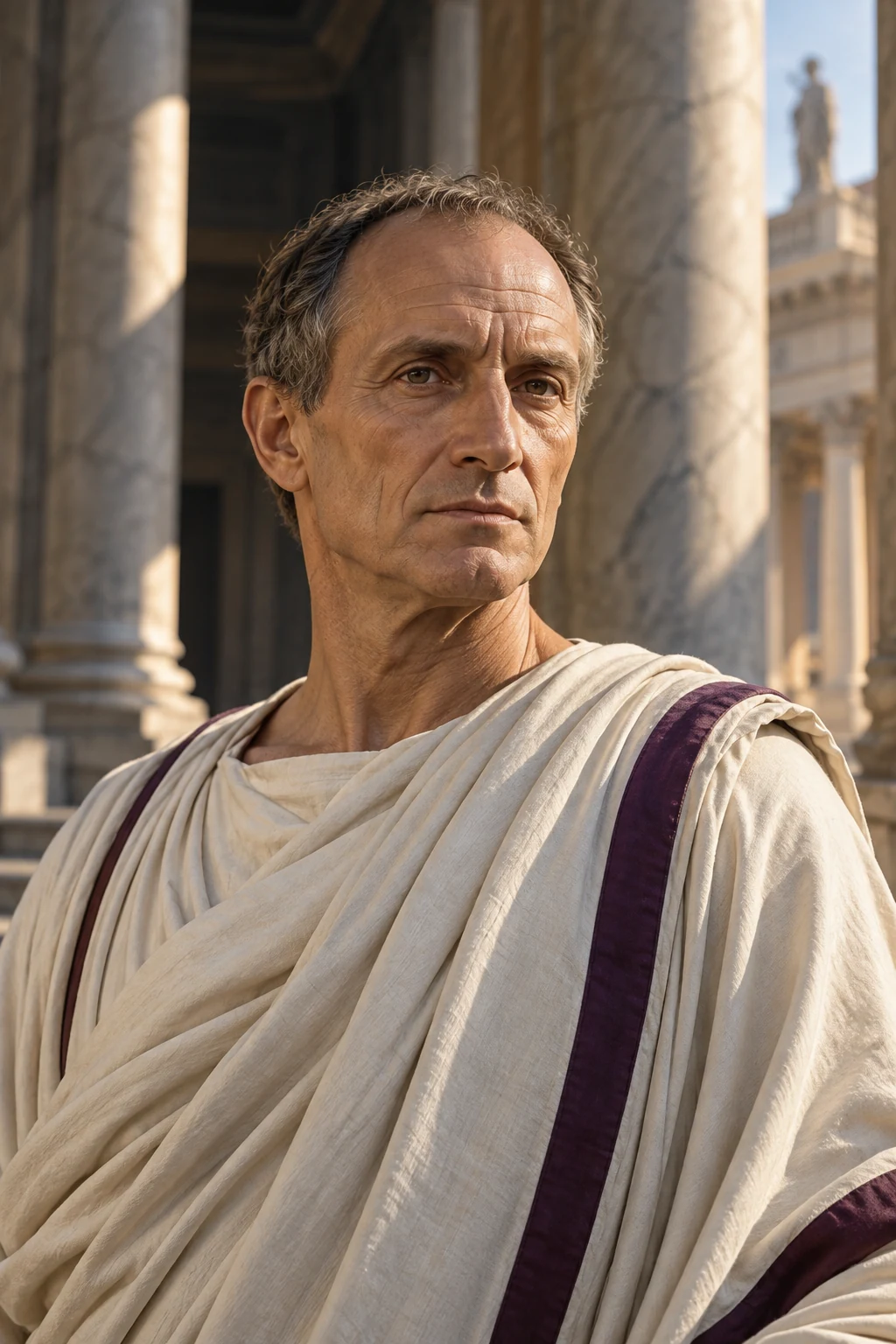
100–44 BCE
Julius Caesar
Roman Republican statesman and general
Became dictator for life after civil war. His assassination did not restore the old Republic; struggles for power continued.
A politician with an army confronts the Republic
Conquest in Gaul gave Caesar military power and prestige. Returning to Roman politics while retaining that power challenged Republican order. Institutions remained, but powerful individuals and armies increasingly shaped political outcomes.
Caesar’s alliance with Pompey and Crassus combined military standing, wealth and political influence. The modern term “First Triumvirate” does not describe three holders of an identical constitutional office. Powerful individuals worked through and competed within republican institutions.
Caesar built authority through military success and political support. Conquest also brought death, enslavement and changed rule to those defeated.
From the Rubicon to perpetual dictatorship
In 49 BCE Caesar crossed the Rubicon with troops rather than disbanding them. This breached a political boundary and began civil war. Defeating Pompey at Pharsalus in Greece in 48 BCE shows how Roman conflict extended beyond Italy.
Civil war beginning in 49 BCE concentrated his power. A Republican emergency office was transformed when its authority became permanent.
Coins of 44 BCE pair Caesar’s image with a perpetual-dictator title. Circulation publicized both face and status. Portraiture functioned as a political claim as well as an image of an individual.
Civil conflict after the assassination
Caesar was assassinated on 15 March 44 BCE. Conflicts over armies, land and territorial control continued. Octavian eventually prevailed and received the title Augustus in 27 BCE. Caesar had been a republican dictator, not the same person as the first emperor who emerged later.
Expansion enriched some while increasing inequality and the burden of distant military commitments. Caesar’s ambition alone cannot explain the crisis. Arguments about institutions and strong leaders belonged within these social and imperial pressures.
His war accounts explain events from the commander’s position. Coins publicly announce dictatorship; later drama reshapes assassination for an audience. These different purposes produce different images of Caesar.
Turning points
- 100 BCE
Born.
- 50s BCE
Conducted campaigns in Gaul.
- 49 BCE
Civil war began.
- 48 BCE
Defeated Pompey’s forces at Pharsalus.
- 44 BCE
Became perpetual dictator and was assassinated in March.
Their legacy
Assassination removed the dictator without ending struggles over armies and power. Octavian’s victory in later civil wars led toward imperial rule retaining Republican institutions.
Related history

Sources
The Metropolitan Museum of Art · Expansion, social tensions, Caesar’s death and succession.
British Museum · The title and representation on a coin of 44 BCE.
Rice University / OpenStax · The alliance, Rubicon crossing, Pharsalus and the civil-war sequence.
The portrait is an original historical imagining, not evidence of the person’s appearance.