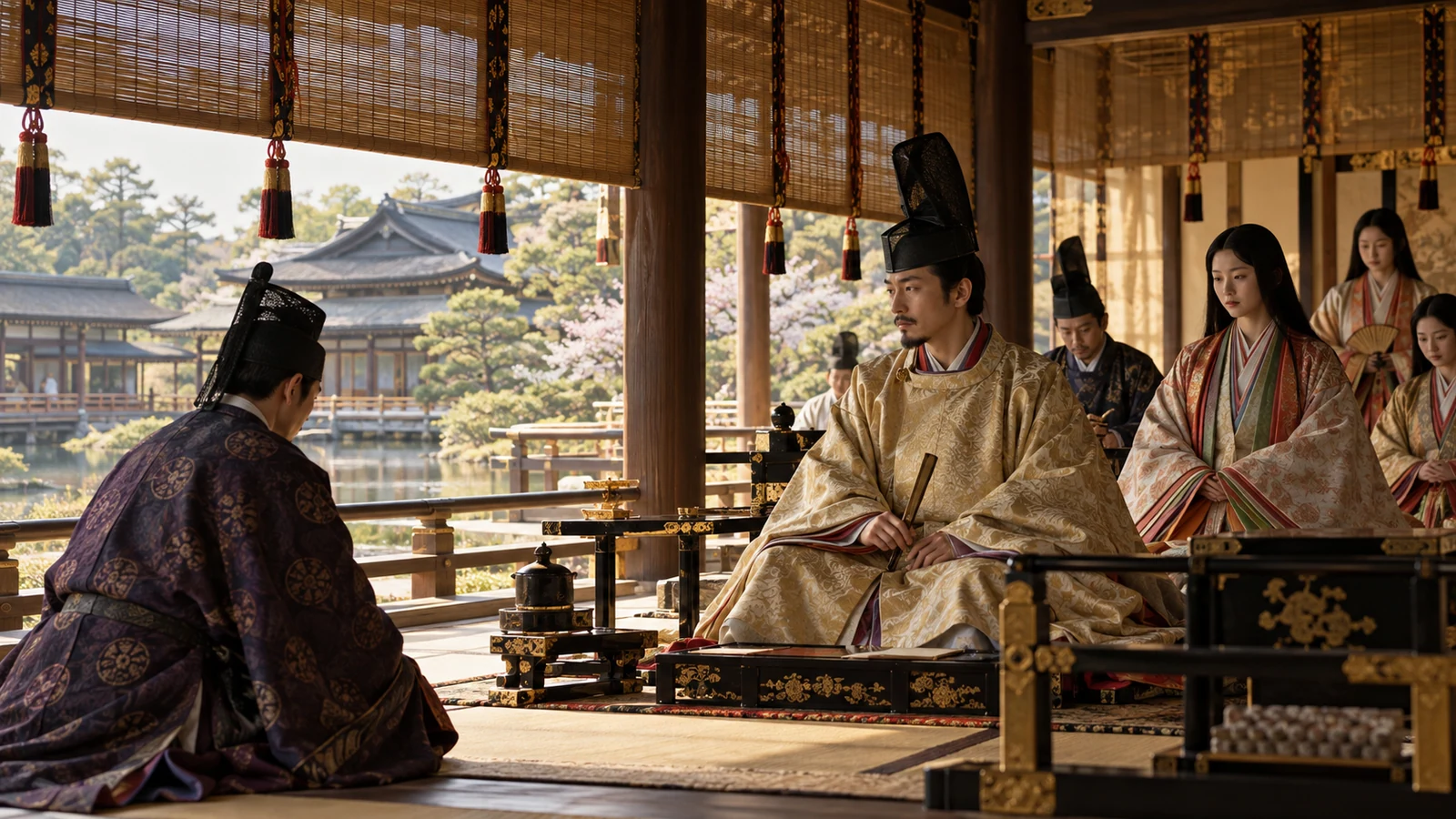
c. 995–1021 · The age of Fujiwara no Michinaga
Family and office behind Michinaga’s power
Imperial marriages, family connections and diaries reveal the workings of regency politics.
Combining office with imperial kinship
Appointment as nairan in 995 gave Michinaga access to imperial administrative business. His daughter Shōshi’s marriage and son’s accession made him an imperial grandfather. Office and family connections combined within the court rather than through a separate warrior government.
Regent and chancellor had different functions, and Michinaga’s authority cannot be explained as a long chancellorship. Appointment, marriage, birth and accession were separate stages. A famous poem alone does not describe those relationships.
Copying and depositing scripture
In 1007 Michinaga deposited scripture he had copied in a gilt-bronze container on Kinpusen. Writing, manufacture and transport joined in a religious act. The inscription identifies his name, status and date, preserving material evidence of action.
The birth in 1008 changed the family’s political position. Contemporary religious interpretation does not establish a modern causal claim that prayer produced the birth. Religious meaning and the resulting kinship relationship can be examined separately.
Women such as Murasaki supplied writing and learning in Shōshi’s court. Murasaki’s account of childbirth and Michinaga’s diary and container preserve related events from different positions and in different forms. Imperial kinship involved a consort and her attendants as well as ruler and father; identifying a source’s standpoint reveals their distinct work.
Transmitting household authority
Ceremonies and family affairs appear together in his diary because household events affected court relationships. Reading it as only private life misses the connections between kinship, offices and ritual.
Yorimichi became regent in 1017. Continued household influence differed from Michinaga personally holding the same office. Appointment, marriage and imperial and household succession sustained authority beyond one individual.
Before and after
- 995
Michinaga is appointed nairan.
- 1007
He deposits a sutra container on Kinpusen.
- 1008
His daughter Shōshi gives birth to a prince.
- 1017
Yorimichi becomes regent, continuing the family’s political role.
Key terms
- Maternal relatives
- Maternal kin whose ties could support imperial succession and politics.
- Regent and chief adviser
- Offices assisting young and adult emperors respectively.
- Nairan
- A position reviewing documents before they reached the emperor.
What supports the account?
Maternal kinship supported Michinaga.
Research and excavation reports connect imperial marriages and kinship to political foundations.
Kinship alone cannot explain every office or rivalry among nobles.
The diary survives discontinuously.
The heritage description gives the autograph diary’s date range.
It is not a complete day-by-day chronology.
Check your understanding
Choose an answer to reveal the explanation. Return to the article and sources when you are unsure.
Sources
- Michinaga and regency politicsお茶の水女子大学・古瀬奈津子
Maternal kinship and Michinaga’s political base; checked through indexed text.
- Kyoto cultural chronology京都市歴史資料館
Dates placing court literature in Michinaga’s age.
- Catalogue of regency-family records文化庁
Michinaga’s autograph diary and surviving date range.
- Excavation report: northern Heian-kyō京都市埋蔵文化財研究所
The 995 appointment, imperial family relationships, Tsuchimikado residence and Hōjōji.
- Chronology of ancient history広島県立文書館
Dates concerning Michinaga’s offices based on court lists and diaries.
- Michinaga’s gilt-bronze sutra container京都国立博物館
Imperial family relationships, the 1007 deposit, the 1008 prince’s birth, inscription and diary.
Keep exploring

1008 · The Tale of Genji appears in a diary
Heian Kyoto and The Tale of Genji
Read a courtly tale alongside the geography of the real capital.
Kyoto1378 · Yoshimitsu moves to his Muromachi residence
Kyoto around the shogun’s residence
Government residences and commercial neighbourhoods gave upper Kyoto different functions.
Upper Kyoto
1401–mid-sixteenth century · Trade with Ming China
The tally checked at the port
A tally identified authorised missions: follow the links between diplomacy and commerce.
Hakata, Fukuoka / Kyoto