
1008 · The Tale of Genji appears in a diary
Heian Kyoto and The Tale of Genji
Read a courtly tale alongside the geography of the real capital.
A court with readers of fiction
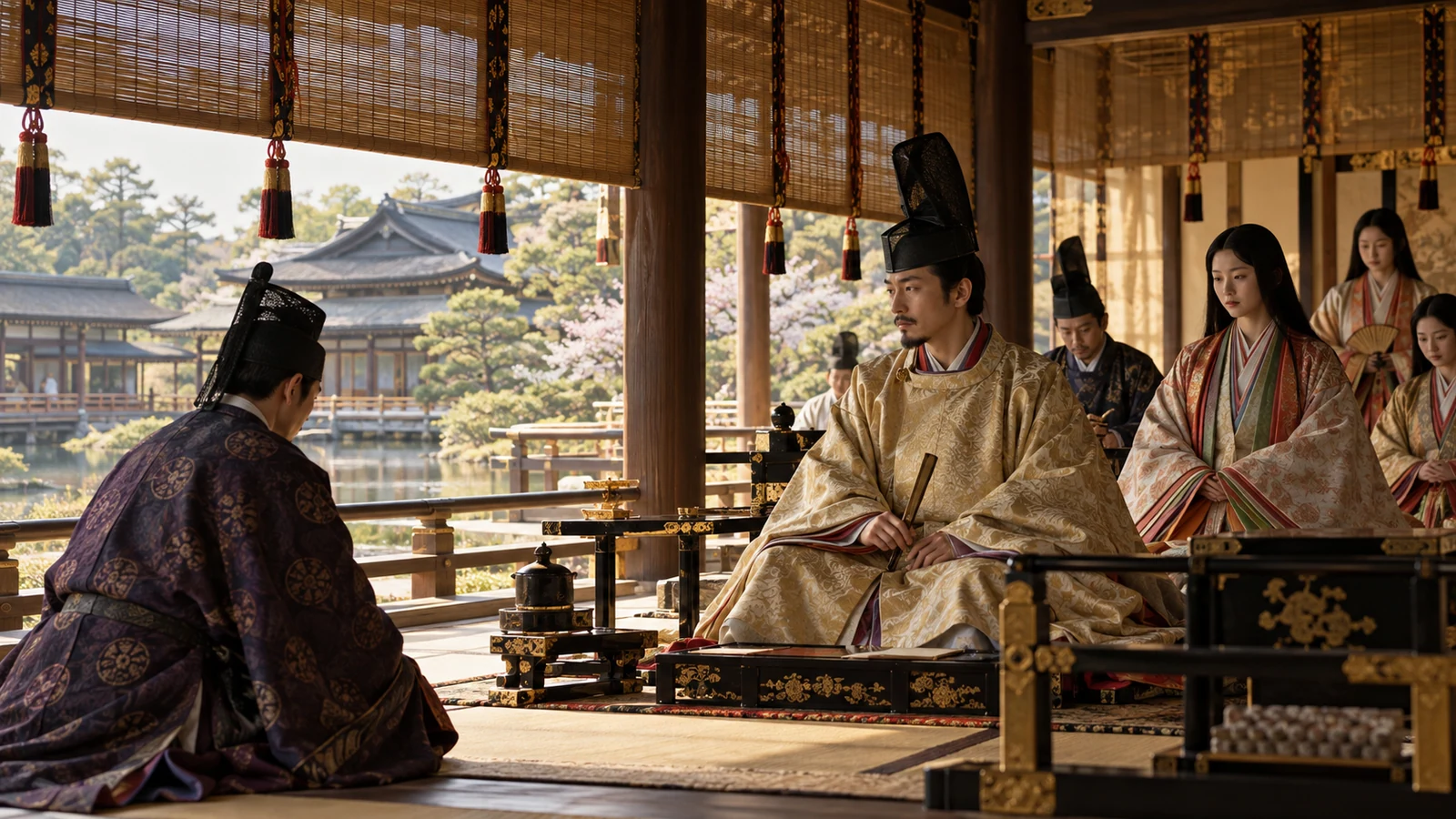
Heian court life joined ceremony with relationships among imperial and aristocratic households. The Tale of Genji draws on that society: family and connections shape its characters’ opportunities. Its romances are therefore intertwined with rank and courtly roles.
The diary’s mention in 1008 establishes readership at that point, not a modern publication date. Handwritten texts circulated through reading and copying, linking composition to the labour of scribes and later transmission.
Poems and diaries in social life
The Kokin Wakashū of 905 assembled poems by imperial command. Poetry also communicated between people. The Tosa Diary around 935 and Pillow Book around 1001 used different forms to describe travel and court life. These varied practices formed the literary setting in which a long narrative such as Genji found readers.
A diary records selected experiences from its writer’s position, whereas fiction creates characters to explore a social world. Reading both reveals courtly scenes from different angles without treating an invented episode as a documented occurrence.
Literature within the city
Tracing palaces, residences, temples and outskirts gives geographical meaning to characters’ visits and separation. Clothing alone cannot explain that life: names and journeys reveal how the city’s space shaped relationships.
Later building included Michinaga’s religious foundation in 1019 and Yorimichi’s conversion of his Uji estate into Byōdōin in 1052. Literature, recorded politics and religious construction belong within the same wider chronology, giving the fictional setting historical depth.
Before and after
- 905
Compilation of Kokin Wakashū.
- c. 1000
Approximate period of The Pillow Book.
- 1008
Genji is mentioned in Murasaki’s diary.
Key terms
- Court literature
- Writing associated with court settings and readership.
- Diary
- Dated writing shaped by its author’s selection.
- Literary-associated site
- A site associated with a work or author, not necessarily evidence of fictional events.
What supports the account?
The work existed by 1008.
The cultural chronology documents the diary reference.
It does not determine exact beginning or completion dates.
Urban layout can be compared with literary settings.
City interpretation connects place names with archaeological research.
It does not prove fictional events occurred.
Check your understanding
Choose an answer to reveal the explanation. Return to the article and sources when you are unsure.
Sources
- Kyoto cultural chronology京都市歴史資料館
The 1008 diary reference and dates of neighbouring literary works.
- Places associated with The Tale of Genji京都市
Interpretive places combining literary settings with historical and archaeological research.
Keep exploring
c. 995–1021 · The age of Fujiwara no Michinaga
Family and office behind Michinaga’s power
Imperial marriages, family connections and diaries reveal the workings of regency politics.
Heian-kyō, Kyoto1378 · Yoshimitsu moves to his Muromachi residence
Kyoto around the shogun’s residence
Government residences and commercial neighbourhoods gave upper Kyoto different functions.
Upper Kyoto
1401–mid-sixteenth century · Trade with Ming China
The tally checked at the port
A tally identified authorised missions: follow the links between diplomacy and commerce.
Hakata, Fukuoka / Kyoto