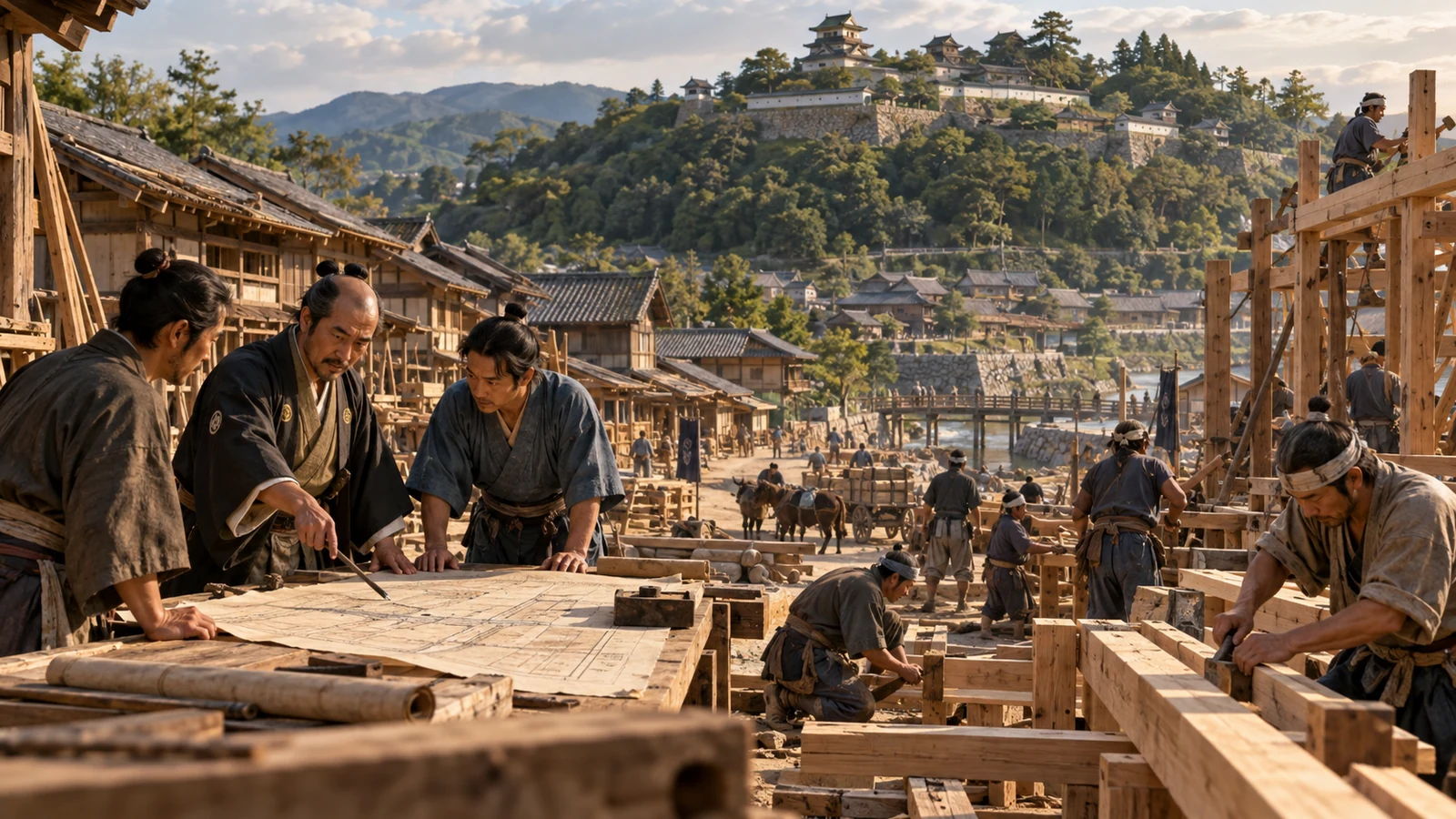
1601 · Sendai Castle and its town
The town Date Masamune built at Sendai
From warlord to domain ruler: castle and town reveal Masamune’s changing role.
Expansion followed by territorial reassignment
Masamune expanded after defeating the Ashina in 1589. Submission at Odawara in 1590 was followed by reassignment and relocation to Iwadeyama in 1591. Local military success differed from authority to reorganise territories nationally.
Mapping successive bases at Yonezawa, Iwadeyama and Sendai reveals altered movement and supply. A 1591 letter documents restrictions amid reassignment. Submission changed practical conditions as well as formal allegiance.
Developing Sendai from 1601
Construction beginning in 1601 established a centre for warriors, merchants and religious institutions as well as defence. Settlement, work and traffic around the castle were part of rule. Military and domestic functions developed together.
Ōsaki Hachimangū was completed in 1607 and retains its building, whereas Sendai Castle is understood through walls and remains. Names including Kokubunchō, Tachimachi and Minamimachi preserve aspects of the town plan. Buildings, remains and names differently record the arrangement of a military centre, commercial town and religious sites.
Beyond the heroic statue
Armour documents objects and craft; letters document instructions and negotiation. A later equestrian statue commemorates rather than performs administration. The practical record reveals building, relocation and movement alongside martial reputation.
Rule under the Tokugawa differed from earlier expansion. Maintaining regional authority required urban development and administration within a wider order. Sendai’s history shows that battlefield success alone cannot explain lasting rule.
Before and after
- 1590
Masamune joins Hideyoshi’s Odawara campaign.
- 1591
His holdings change and he relocates to Iwadeyama.
- 1601
Work begins on Sendai Castle.
- 1607
Ōsaki Hachimangū is completed.
Key terms
- Transfer of domain
- Moving a lord’s allotted territory.
- Castle town
- A town organised around castle, warrior and commercial districts.
- Armour
- A set of protective equipment including cuirass and helmet.
What supports the account?
Masamune experienced subordination and relocation.
The city museum documents the events of 1590 and 1591.
Do not turn the life into uninterrupted expansion.
Castle and shrine reveal different construction activities.
The collection guide covers the castle and 1607 shrine.
Do not treat the present castle memorial statue as original construction.
Check your understanding
Choose an answer to reveal the explanation. Return to the article and sources when you are unsure.
Sources
- Sendai Castle site仙台市
Masamune’s construction and archaeological evidence from walls and buildings.
- Records concerning Date Masamune仙台市博物館
Castle town, castle, Ōsaki Hachimangū and Masamune’s life.
- Masamune in the age of wars仙台市博物館
Expansion, submission in 1590 and relocation in 1591.
- Masamune letter, object 2277仙台市博物館
Territorial reassignment, movement restrictions and supply routes in 1591; checked in indexed catalogue text.
Keep exploring
1105–1189 · Hiraizumi under the Northern Fujiwara
Hiraizumi, a centre of Buddhist devotion
Follow the family that built major Buddhist temples in northeastern Japan.
Hiraizumi, Iwatec. 3900–2200 BCE · Jōmon period
Life at Sannai-Maruyama
Homes, storage pits and imported stone reveal life in a large Jōmon settlement.
Sannai-Maruyama, Aomori
1600 · Fifteenth day of the ninth lunar month
Reading Sekigahara through its records
Separate the battle’s date from the later stories told about it.
Sekigahara, Gifu