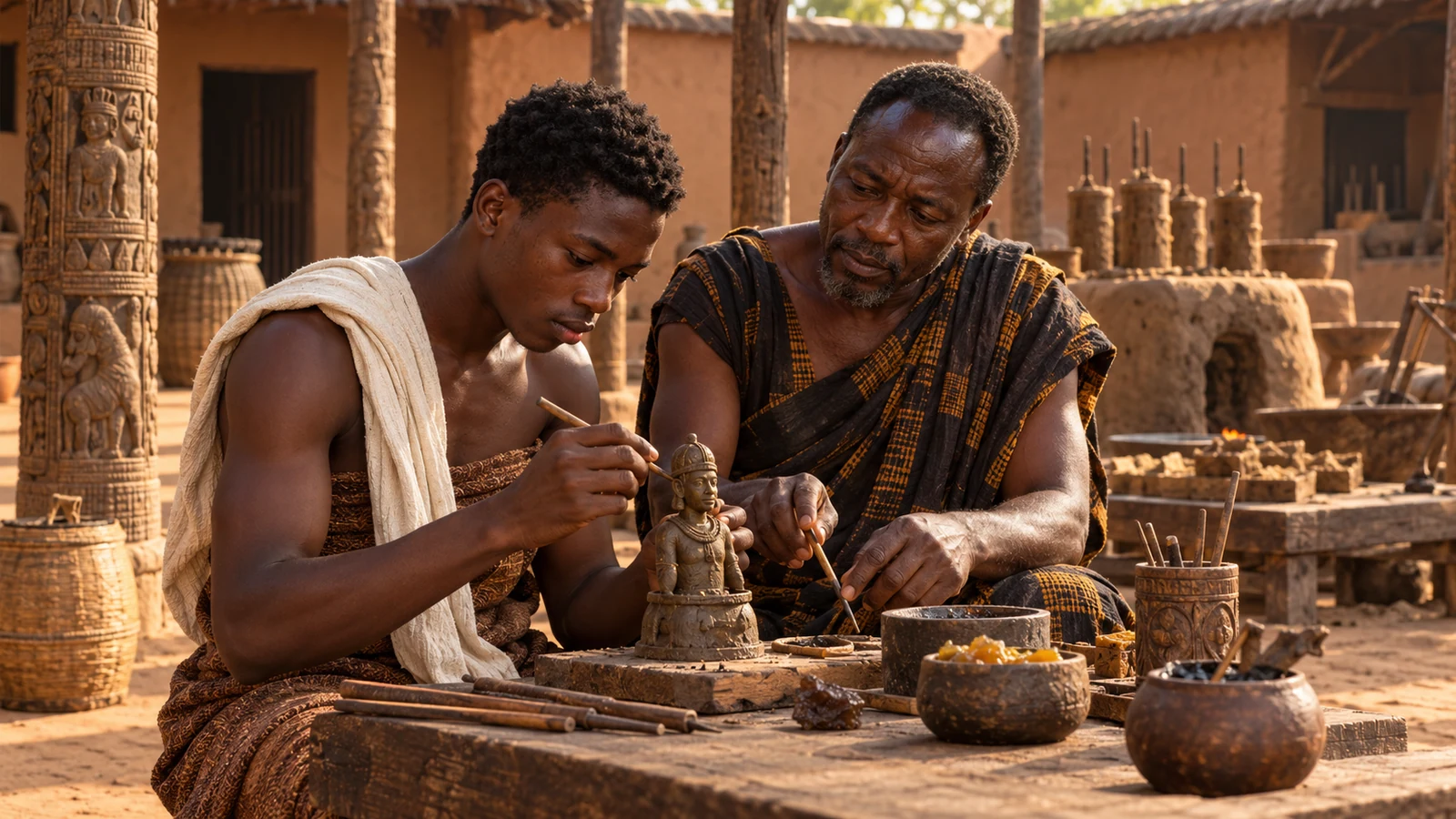
Around 1600 · Benin City · A workshop in the West African Edo kingdom
From wax pattern to metal form
Osa, an apprentice in the Edo kingdom
Follow the workshop as a wax model becomes metal.
The clay mould breaks when the casting is removed. Where does the original form survive?
Begin the storyPreparing your story…
Explore the diagram: Metal takes the space left by wax
Metal takes the space left by wax
Can the same direct-casting mould be reused after removing the object?
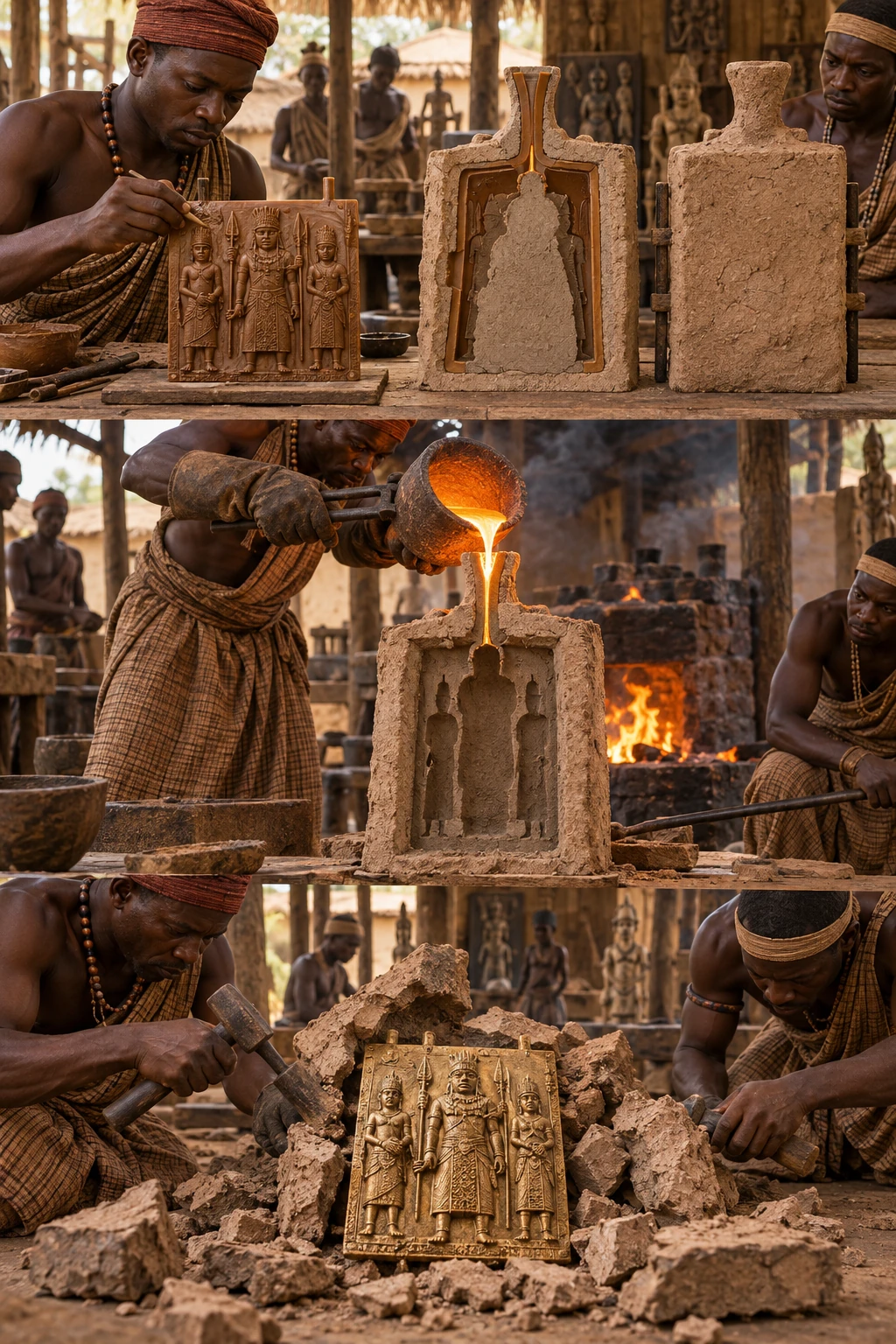
The wax shape is enclosed by clay.
The design starts in wax
Details are modelled in wax and enclosed in clay. Fine inner layers capture detail; outer layers strengthen the mould. The cutaway shows how clay encloses the wax model.
Sources and scope
These illustrations explain processes and institutions rather than reconstructing actual people, buildings or layouts. Cutaways and insets show hidden structures or separate locations.
African lost-wax casting ↗Osa, nineteen, his master, the small plaque and its commission are fictional, not a replica of a museum object. Processes are simplified and allocation tokens fictional. Activities give no practical temperatures, alloy recipes or casting instructions.
Explore the time and placeSources
- Benin Bronzes ↗
British Museum · Court guilds, materials, ritual, the 1897 conquest and looting.
- Benin brass bracelet ↗
British Museum · Lost-wax casting, date range and the 1897 acquisition and looting history.
- Collecting histories ↗
British Museum · Objects displaced by military action and provenance investigation.
- African Lost-Wax Casting ↗
The Metropolitan Museum of Art · Wax models, clay layers, drying, firing, wax removal and breaking the mold after cooling.