1536 or 1537–1598
Toyotomi Hideyoshi
Warlord and political unifier
A key figure in consolidation after Honnōji. Sources give both 1536 and 1537 for his birth; this record preserves the range.
From a lord’s death toward new authority
The deaths of Nobunaga and Nobutada in 1582 raised separate questions of family succession and military command. Hideyoshi, formerly a retainer, followed victory at Yamazaki with further negotiation and fighting on his path to authority.
After Honnōji in 1582, Hideyoshi defeated Mitsuhide at Yamazaki and Shibata Katsuie the following year. One victory did not transfer all Oda authority: Sanbōshi and Nobunaga’s sons remained. Nominal succession and practical control differed, and negotiation and war moved a former retainer into the center of government.
Survey registers and the sword hunt
Different measures and land grades complicated comparison of dues. Surveys connected area, productivity and cultivators in registers. They established administrative standards while rewriting local rights and burdens, consolidating power to govern land and people through records beyond simple map accuracy.
Weapons collection orders sought to disarm cultivators and direct them toward farming. An order’s date does not establish when every locality changed practice. Registers and regulations record what government demanded of villages.
Work behind Osaka and tea culture
Osaka Castle concentrated military and administrative activity. Building materials were followed by continuing deliveries of food and tools. Construction and sustained use had different timescales. Craftspeople, merchants and carriers kept the impressive complex usable for daily government.
Tea practitioners such as Sen no Rikyū shaped utensils and settings. Tea gatherings also expressed relationships. Rustic and sumptuous aesthetics coexisted; patrons, practitioners and craftspeople contributed differently to this cultural world.
The invasions of Korea and succession after his death
Hideyoshi ordered invasions of Korea in 1592 and 1597. Korean forces and civilians, Ming reinforcements and Japanese troops and supplies were involved; maritime logistics mattered. Withdrawal followed his death in 1598, without undoing destruction and forced removal. Domestic unification and responsibility for invasion belong to the same life.
Arrangements involving powerful lords and administrators sought succession by the young Hideyori. Family and other leaders’ interests did not secure lasting agreement after Hideyoshi died. Military unification differed from stable inherited authority; Ieyasu’s rise involved this remaining problem of succession and power.
Turning points
- 1536 or 1537
Born in Owari; the year is debated.
- 1582
Defeated Mitsuhide at Yamazaki.
- 1583
Began Osaka Castle.
- 1580s
Extended land surveys and weapons collection.
- 1592 and 1597
Launched invasions of Korea.
- 1598
Died.
Their legacy
Land registers linked fields, cultivators and obligations; weapons collection intervened in arms possession. The regime developing domestic government also ordered invasions of Korea, whose devastation belongs to the same history.
Related history
1582 · Second day of the sixth lunar month
Honnōji and the city of Kyoto
Trace the two sites of Nobunaga’s and Nobutada’s deaths, Mitsuhide’s defeat and the temple’s later relocation through Kyoto.
Kyoto1609 · Completion of the present great keep
Dating the buildings of Himeji Castle
The great keep and western enclosure belong to different stages of construction.
Himeji, HyōgoRelated stories
Sources
名古屋市 · Hideyoshi’s career, land surveys, weapons collection and religious policies.
大阪城天守閣 · Campaigns and expansion of power in 1582–1584.
The Metropolitan Museum of Art · Unifying regimes, art and Hideyoshi’s invasions of Korea.
岐阜市 · Sanbōshi, Nobutaka, Hideyoshi and succession after Honnōji.
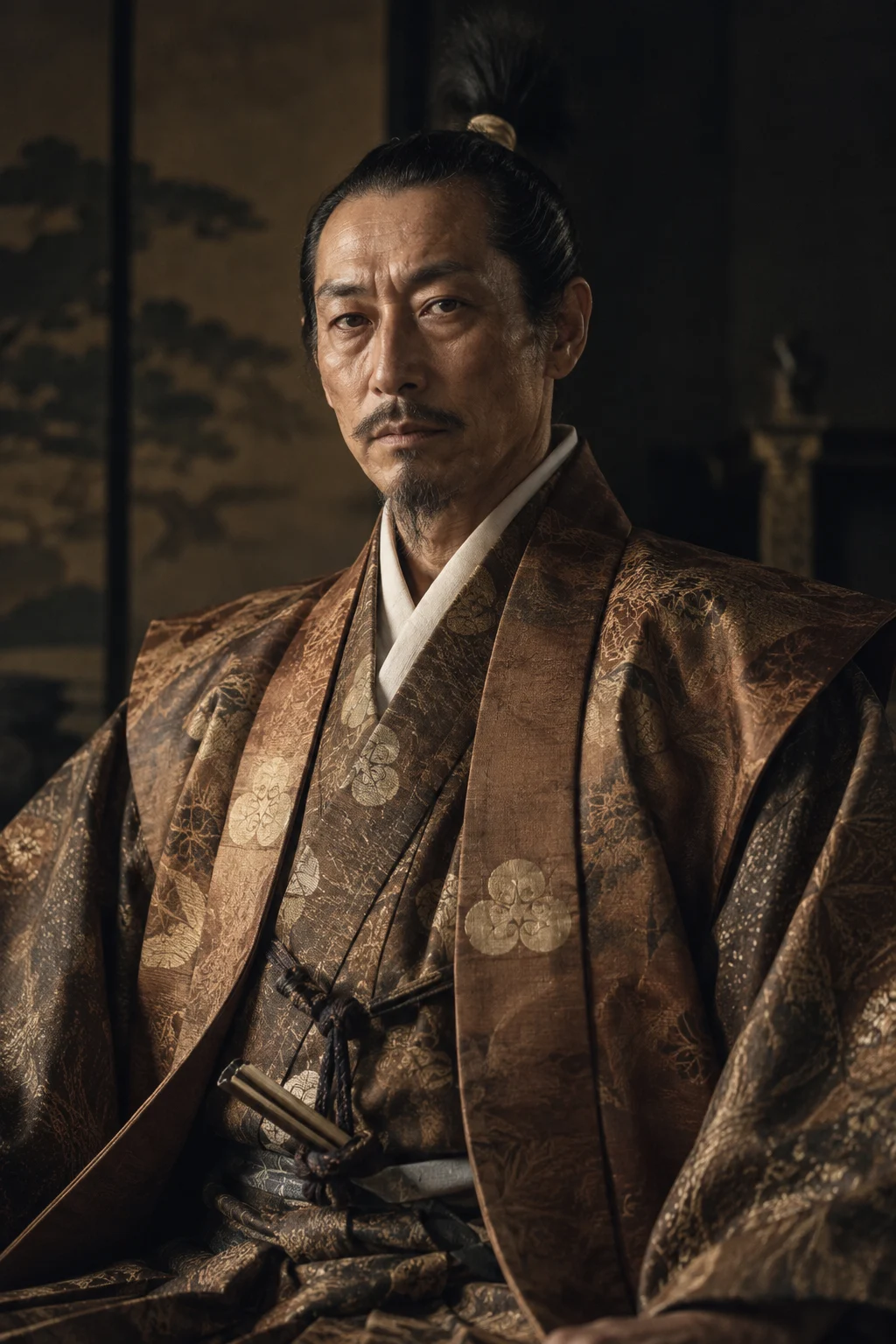
The portrait is an original historical imagining, not evidence of the person’s appearance.