
?–1582
Akechi Mitsuhide
General in Oda service
Led the forces that attacked Honnōji and later lost at Yamazaki. Details of his birth and the motive for his decision are not asserted.
Governing Tanba before the rebellion
Before attacking Honnōji, Mitsuhide was an important retainer governing Tanba under Nobunaga. Based at Kameyama, he managed troops, supplies and regional relationships. Dated letters reveal activity before the rebellion despite uncertainty about his early life.
Kameyama’s proximity to Kyoto made its roads and regional information significant. Holding captured territory demanded communication and resources, not only a garrison. Military and administrative responsibilities accumulated before 1582 and underpinned Mitsuhide’s position within the regime.
Dated devotional letters and the attack of 1582
Letters concerning prayers at Atago survive from 1575 and 1579. Their dates and recipients document religious and regional relationships. They do not directly establish the later rebellion’s motive; treating all earlier activity as a warning of Honnōji erases its contemporary setting.
He attacked Honnōji in 1582, where Nobunaga died. His son Nobutada also died that day, at the separate Nijō residence rather than Honnōji. A sequence of actions does not establish inner motives.
The army entering Kyoto from Kameyama brought about the deaths of father and son at separate sites. Mitsuhide then needed bases in the Kinai and support from other commanders, under severe time pressure before Yamazaki.
A short interval to gather support before Yamazaki
After defeating Nobunaga, Mitsuhide sought control and support in the Kinai, but Oda retainers did not automatically follow him. On the thirteenth day of the sixth lunar month in 1582, he lost at Yamazaki and died during retreat. “Three-day rule” is a label for brevity, not the literal interval since the attack on the second day.
Tanba’s local remembrance emphasizes governing work as well as revolt. Different judgments focus on different acts. Letters and sites move study beyond a good-or-bad verdict toward command, administration and succession.
Turning points
- Sixteenth century
Born; the exact year is unknown.
- 1575
Participated in Tanba campaigns; a letter to Atago survives.
- Late 1570s
Established a base at Kameyama Castle.
- 1579
A letter concerning prayers at Atago survives.
- Sixth month of 1582 in the historical calendar
Attacked Honnōji and later lost at Yamazaki.
Their legacy
Removing his lord did not secure the support of surviving retainers. The brief period before Yamazaki records Mitsuhide’s failure to turn a successful attack into durable government.
Related history
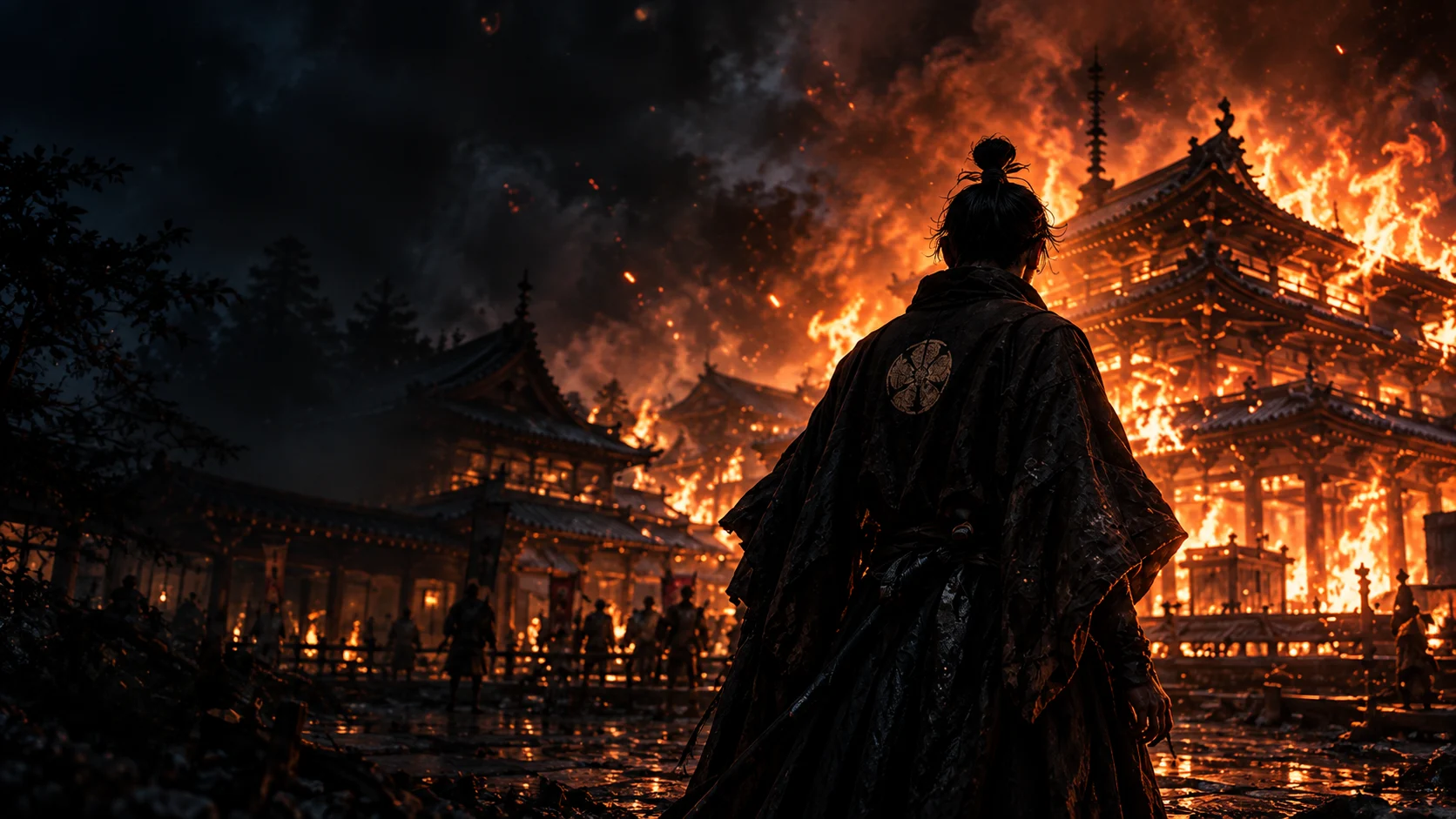
1582 · Second day of the sixth lunar month
Honnōji and the city of Kyoto
Trace the two sites of Nobunaga’s and Nobutada’s deaths, Mitsuhide’s defeat and the temple’s later relocation through Kyoto.
Kyoto1378 · Yoshimitsu moves to his Muromachi residence
Kyoto around the shogun’s residence
Government residences and commercial neighbourhoods gave upper Kyoto different functions.
Upper KyotoRelated stories
Sources
京都市考古資料館 · Events of 1582 and Kyoto sites, distinguishing Honnōji from the Nijō residence.
亀岡市 · Tanba campaigns, Kameyama Castle and the departure in 1582.
亀岡市 · Mitsuhide’s dated letters and prayers at Atago.
The portrait is an original historical imagining, not evidence of the person’s appearance.